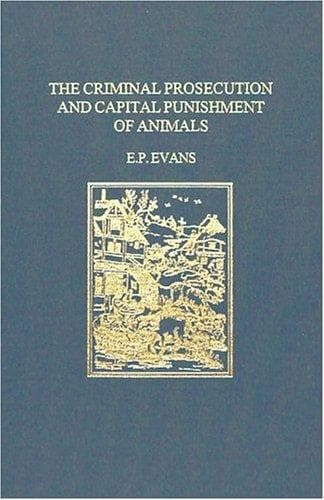
The Criminal Prosecution and Capital Punishment of Animals — John Shaqi
The Criminal Prosecution and Capital Punishment of AnimalsEvans, E. P. (Edward Payson)
History
The Criminal Prosecution and Capital Punishment of Animals
Evans, E. P. (Edward Payson)
Animals -- Law and legislation -- History; Animals, Prosecution and punishment of -- History; Trials -- Europe
According to the Psalmist, the hart panting after the water-brooks
represents the soul thirsting for the living God and is the type of
religious ardour and aspiration. It plays an important part in the legends
of saints, acts as their guide, shows them where holy relics are
concealed, and causes St. Eustace and St. Hubert to abandon the chase and
to lead lives of pious devotion by appearing to them with a luminous cross
between its antlers. The ten branches of its horns symbolize the ten
commandments of the Old Testament and signify in the Roman ritual the ten
fingers of the outstretched hand of the priest as he works the perpetual
miracle of transubstantiation of the eucharist.
Chief of the stenchy beasts is the pig. In paganism, which to the
Christians was merely devil-worship, the boar was an object of peculiar
adoration; for this reason the farrow of the sow is supposed to number
seven shotes, corresponding to the seven deadly sins. To the same class of
offensive beasts belong the wolf, typical of bad spiritual shepherds, and
the fox, which is described as follows: “Reynard is a beast of small size,
with red hair, a long bushy tail and an evil physiognomy, for his visage
is thin and sharp, his eyes deep-set and piercing, his ears small,
straight and pointed; moreover he is deceitful and tricky above all other
beasts and exceedingly malicious.” “We are all,” adds Queen Reason in a
moralizing strain, “more or less of the brotherhood of Saint Fausset,
whose influence is now-a-days quite extended.” Among birds the raven is
pre-eminently a malodorous creature and imp of Satan, whereas the dove is
a sweet beast and the chosen vessel for the outpouring of the Holy Spirit,
the form in which the third person of the Trinity became incarnate.
Public-domain text, read in full here on John Shaqi.
Reviews
Reviews
No reviews yet
Be the first to share your thoughts on this work.
Join the Discussion
Join the discussion
Sign in to leave a comment or review.
Sign InorCreate an account