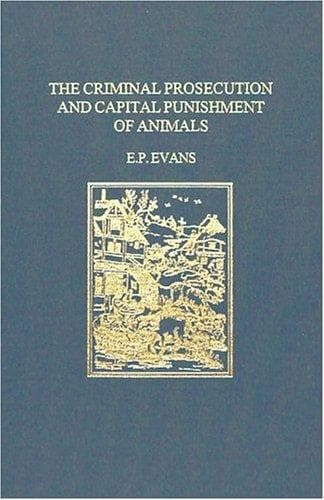
The Criminal Prosecution and Capital Punishment of AnimalsEvans, E. P. (Edward Payson)
History
The Criminal Prosecution and Capital Punishment of Animals
Evans, E. P. (Edward Payson)
Animals -- Law and legislation -- History; Animals, Prosecution and punishment of -- History; Trials -- Europe
subduing and extirpating evil, is surely a sublime thought and a source of
lofty inspiration and encouragement in well-doing, although it has been
degraded by Parsi Dasturs--as all grand conceptions and ideals are apt to
be under priestly influences--into a ridiculous and childish hatred of
snakes, scorpions, frogs, lizards, water-rats, and other animals supposed
to have been produced by Angrô-mainyush.
Plato held a similar theory of creation, regarding it not as the
manifestation of pure benevolence endowed with almighty power, but rather
as the expression of perfect goodness working at disadvantage in an
intractable material, which by its inherent stubbornness prevented the
full embodiment and realization of the original purpose and desire of the
Creator or Cosmourgos, who was therefore obliged to content himself with
what was, under the circumstances, the only possible, but by no means the
best imaginable, world. The Manicheans attributed the same unsatisfactory
result to the activity of an evil principle, which thwarted the complete
actualization of the designs of the Deity. So conspicuous, indeed, is the
defectiveness of nature as a means of promoting the highest conceivable
human happiness, so marked and manifold are the causes of suffering in all
spheres of sentient existence, and so often do the elements seem to
conspire for the destruction of mankind, raging relentlessly like a wild
beast
“Red in tooth and claw
With ravin,”
that every cosmogony has been compelled to assume the persistent
intervention of some malignant spirit or perverse agency as the only
rational explanation of such a condition of things. The orthodox
Christianity of to-day gives over the earth entirely to the sovereignty of
Satan, the successful usurper of Eden, and instead of bidding the
righteous to look forward to the final re-enthronement and absolute
supremacy of truth and goodness in this world as the
“One far-off divine event,
To which the whole creation moves,”
consoles them with the vague promise of compensation in a future state of
being. Even this remote prospect of redemption is confined to a select
few; not only is the earth destined to be burned with fire on account of
its utter corruption, but the great majority of its inhabitants are doomed
to eternal torments in the abode of evil spirits.
Public-domain text, read in full here on John Shaqi.
Reviews
Reviews
No reviews yet
Be the first to share your thoughts on this work.
Join the Discussion
Join the discussion
Sign in to leave a comment or review.
Sign InorCreate an account