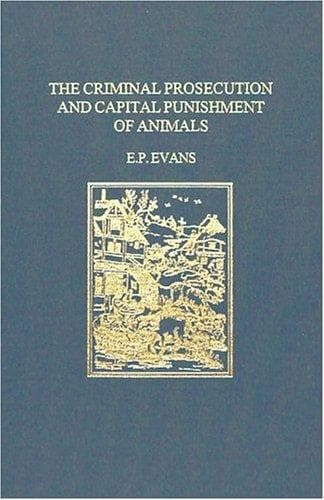
The Criminal Prosecution and Capital Punishment of Animals — John Shaqi
The Criminal Prosecution and Capital Punishment of AnimalsEvans, E. P. (Edward Payson)
History
The Criminal Prosecution and Capital Punishment of Animals
Evans, E. P. (Edward Payson)
Animals -- Law and legislation -- History; Animals, Prosecution and punishment of -- History; Trials -- Europe
Scientific research also leads to the same conclusions in respect to the
incompleteness of Nature’s handiwork, which it is the function of art and
culture to amend and improve. Everywhere the correcting hand and
contriving brain of man are needed to eliminate the worthless and noxious
productions, in which Nature is so fatally prolific, and to foster and
develop those that are useful and salutary, thus beautifying and ennobling
all forms of vegetable and animal life. By a like process man himself has
attained his present pre-eminence. Through long ages of strife and
struggle he has emerged from brutishness and barbarism, and rising by a
slow, spiral ascent, scarcely perceptible for generations, has been able
gradually to
“Move upward, working out the beast,
And let the ape and tiger die.”
The more man increases in wisdom and intellectual capacity, the more
efficient he becomes as a co-worker with the good principle. At the same
time, every advance which he makes in civilization brings with it some new
evil for him to overcome; or, as the Parsi would express it
mythologically, every conquest achieved by Ahuramazda and his allies
stimulates Angrômainyush and his satellites to renewed exertions, who
convert the most useful discoveries, like dynamite, into instruments of
diabolical devastation. The opening of the Far West in the United States
to agriculture and commerce, and the completion of the Pacific Railroad,
not only served to multiply and diffuse the gifts of the beneficent and
bountiful spirit (_speñtô mainyush_), but also facilitated the propagation
and spread of the plagues of the grasshopper and the Colorado beetle. The
power of destruction insidiously concealed in the minutest insect organism
often exceeds that of the tornado and the earthquake, and baffles the most
persistent efforts of human ingenuity to resist it. The genius and energy
of Pasteur were devoted for years to the task of detecting and destroying
a microscopic parasite, which threatened to ruin for ever the silk
industry of France; and the Phylloxera and Doryphora still continue to
ravage with comparative impunity the vineyards of Europe and the
potato-fields of America, defying at once all the appliances of science
for their extermination and all the attempts of casuistic theology to
reconcile such scourges with a perfectly benevolent and omnipotent Creator
and Ruler of the Universe. It is the observation of phenomena like these
that confirms the modern Parsi in the faith of his fathers, and reveals to
him, in the operations of nature and the conflicts of life, unquestionable
evidences of a contest between warring elements personified as Hormazd
and Ahriman, the ultimate issue of which is to be the complete triumph of
the former and the consequent purification and redemption of the world
from the curse of evil. The Parsi, however, recognizes no Saviour, and
repudiates as absurd and immoral any scheme of atonement whereby the
Public-domain text, read in full here on John Shaqi.
Reviews
Reviews
No reviews yet
Be the first to share your thoughts on this work.
Join the Discussion
Join the discussion
Sign in to leave a comment or review.
Sign InorCreate an account