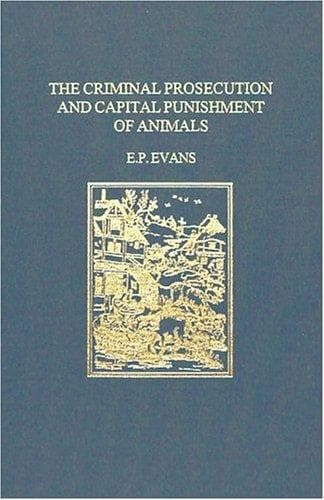
The Criminal Prosecution and Capital Punishment of AnimalsEvans, E. P. (Edward Payson)
History
The Criminal Prosecution and Capital Punishment of Animals
Evans, E. P. (Edward Payson)
Animals -- Law and legislation -- History; Animals, Prosecution and punishment of -- History; Trials -- Europe
“Gentlemen, these poor people on their knees and with tearful eyes, appeal
to your sense of justice, as the inhabitants of the islands Majorica and
Minorica formerly sent an embassy to Augustus Cæsar, praying him for a
cohort of soldiers to exterminate the rabbits, which were burrowing in
their fields and consuming their crops. In the power of excommunication
you have a weapon more effective than any wielded by that emperor to save
these poor suppliants from impending famine produced by the ravages of
little beasts, which spare neither the corn nor the vines, ravages like
those of the boar that laid waste the environs of Calydon, as related by
Homer in the first book of the _Iliad_, or those of the foxes sent by
Themis to Thebes, which destroyed the fruits of the earth and the cattle
and assailed even the husbandmen themselves. You know how great are the
evils which famine brings with it, and you have too much kindness and
compassion to permit my clients to be involved in such distress, thus
constraining them to perpetrate cruel and unlawful deeds; _nec enim
rationem patitur, nec ulla aequitate mitigatur, nec prece ulla flectitur
esuriens populus_: for a starving people is not amenable to reason, nor
tempered by equity, nor moved by any prayer. Witness the mothers, of whom
it is recorded in the Fourth Book of the Kings, that they ate their own
children, the one saying to the other: ‘Give thy son that we may eat him
to-day, and we will eat my son tomorrow.’” The advocate then discourses at
length of the horrors of hunger and its disastrous effects upon the
individual and the community, lugging in what Milton calls a “horse-load
of citations” from Arianus Marcellinus, Ovid and other Latin prosaists and
poets, introduces an utterly irrelevant allusion to Joshua and the crafty
Gibeonites, and concludes as follows: “The full reports received as the
result of an examination of the fields, made at your command, suffice for
your information concerning the damage done by these animals. It remains,
therefore, after complying with the usual forms, only to adjudicate upon
the case in accordance with the facts stated in the Petition of the
Plaintiffs, which is right and reasonable, and, to this effect, to enjoin
these animals from continuing their devastations, ordering them to quit
the aforesaid fields and to withdraw to the place assigned them,
pronouncing the necessary anathemas and execrations prescribed by our Holy
Mother, the Church, for which your petitioners do ever pray.”
It is doubtful whether any speaking for Buncombe in the halls of Congress
or any spouting of an ignorant bumpkin in the moot-court of an American
law-school ever produced such a rhetorical hotchpotch of “matter and
impertinency mixed” as the earnest plea, of which the above is a brief
abstract.
Rather more to the point, but equally overburdened with legal lore and
literary pedantry, is the rejoinder of the counsel for the insects:
Public-domain text, read in full here on John Shaqi.
Reviews
Reviews
No reviews yet
Be the first to share your thoughts on this work.
Elsewhere in the archive
Join the Discussion
Join the discussion
Sign in to leave a comment or review.
Sign InorCreate an account