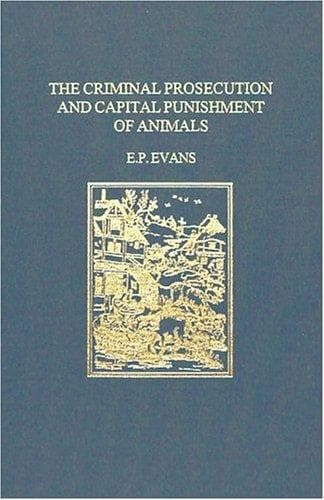
The Criminal Prosecution and Capital Punishment of AnimalsEvans, E. P. (Edward Payson)
History
The Criminal Prosecution and Capital Punishment of Animals
Evans, E. P. (Edward Payson)
Animals -- Law and legislation -- History; Animals, Prosecution and punishment of -- History; Trials -- Europe
declares, have been changed from the house of God into houses of
assignation. On this point he quotes from Tertullian, Augustine, and Numa
Pompilius, and concludes by recommending that sentence of excommunication
be pronounced upon the insects, and that the prayers and penances,
customary in such cases, be imposed upon the inhabitants.
After this discourse, which reads more like a homily from the pulpit than
a plea at the bar and in the mouth of the bishop’s proctor is simply an
_oratio pro domo_, the official gave judgment in favour of the plaintiffs.
The sentence, which was pronounced in Latin befitting the dignity and
solemnity of the occasion, condemned the defendants to vacate the premises
within six days on pain of anathema.
The official begins by stating the case as that of “The People _versus_
Locusts,” declaring that the guilt of the accused has been clearly proved
“by the testimony of worthy witnesses and, as it were, by public rumour,”
and inasmuch as the people have humbled themselves before God and
supplicated the Church to succour them in their distress, it is not
fitting to refuse them help and solace. “Walking in the footsteps of the
fathers, sitting on the judgment-seat, having the fear of God before our
eyes and confiding in his mercy, relying on the counsel of experts, we
pronounce and publish our sentence as follows:
“In the name and by virtue of God, the omnipotent, Father, Son and Holy
Spirit, and of Mary, the most blessed Mother of our Lord Jesus Christ, and
by the authority of the holy apostles Peter and Paul, as well as by that
which has made us a functionary in this case, we admonish by these
presents the aforesaid locusts and grasshoppers and other animals by
whatsoever name they may be called, under pain of malediction and anathema
to depart from the vineyards and fields of this district within six days
from the publication of this sentence and to do no further damage there or
elsewhere.” If, on the expiration of this period, the animals have refused
to obey this injunction, then they are to be anathematized and accursed,
and the inhabitants of all classes are to beseech “Almighty God, the
dispenser of all good gifts and the dispeller of all evils,” to deliver
them from so great a calamity, not forgetting to join with devout
supplications the performance of all good works and especially “the
payment of tithes without fraud according to the approved custom of the
parish, and to abstain from blasphemies and such other sins as are of a
public and particularly offensive character.” (_Vide_ Appendix B.)
Public-domain text, read in full here on John Shaqi.
Reviews
Reviews
No reviews yet
Be the first to share your thoughts on this work.
Elsewhere in the archive
Join the Discussion
Join the discussion
Sign in to leave a comment or review.
Sign InorCreate an account