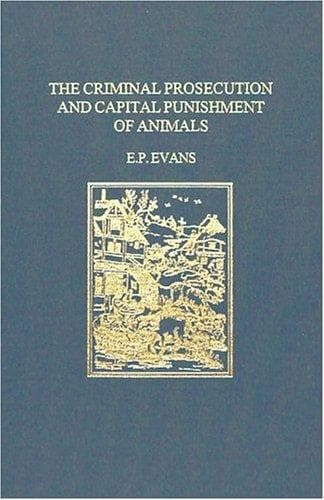
The Criminal Prosecution and Capital Punishment of AnimalsEvans, E. P. (Edward Payson)
History
The Criminal Prosecution and Capital Punishment of Animals
Evans, E. P. (Edward Payson)
Animals -- Law and legislation -- History; Animals, Prosecution and punishment of -- History; Trials -- Europe
The fact that it was customary to catch several
specimens of the culprits and bring them before the seat of justice, and
there solemnly put them to death while the anathema was being pronounced,
proves that this summary manner of dealing would have been applied to the
whole of them, had it been possible to do so. Indeed, the attempt was
sometimes made to get rid of them by setting a price on their heads, as
was the case with the plague of locusts at Rome in 880, when a reward was
offered for their extermination, but all efforts in this direction proving
futile, on account of the rapidity with which they propagated, recourse
was had to exorcisms and be-sprinklings with holy water.
D’Addosio speaks of the actions brought against domestic animals for
homicide as penal prosecutions, and those instituted against insects and
vermin for injury done to the fruits of the field as civil suits
(_processi civili_); but the latter designation is not correct in any
proper sense of the term, since these actions were not suits to recover
for damages to property, but had solely a preventive or prohibitive
character. The judicial process was preliminary to the utterance of the
malediction and essential to its efficacy. Before fulminating an
excommunication the whole machinery of justice was put in motion in order
to establish the guilt of the accused, who were then warned, admonished,
and threatened, and, in cases of obduracy, smitten with the _anathema
maranatha_ and devoted to utter destruction. As with all bans, charms,
exorcisms, incantations, and other magical hocus-pocus, the omission of
any formality would vitiate the whole procedure, and, by breaking the
spell, deprive the imprecation or interdiction of its occult virtue.
Ecclesiastical thunder would thus be robbed of its fatal bolt and reduced
to mere empty noise, the harmless explosion of a blank cartridge.
Public-domain text, read in full here on John Shaqi.
Reviews
Reviews
No reviews yet
Be the first to share your thoughts on this work.
Join the Discussion
Join the discussion
Sign in to leave a comment or review.
Sign InorCreate an account