India -- History -- British occupation, 1765-1947 -- Fiction; Invalids -- Fiction; Simla (India) -- Fiction
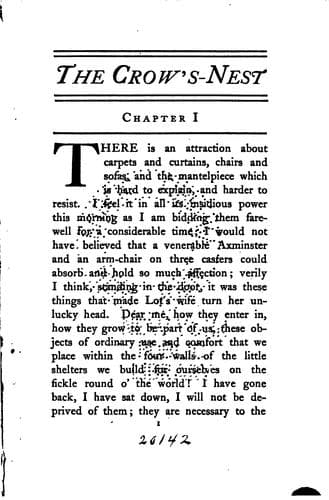
The asterisks stand for the time I have spent in looking at it. Freely
translated they should express an apology. I find it one of the
pernicious tendencies of living on this shelf that my eyes constantly
wander out there taking my mind with them, which at once becomes no
more than a vacant mirror of blue abysses. I look, I know, immensely
serious and thoughtful, and Thisbe, believing me on the tip of some
high imagination goes round the other way, whereas I am the merest
reflecting puddle with exactly a puddle’s enjoyment of the scene. There
is neither virtue nor profit in this, but if I apologized every time
I did it these chapters would be impassable with asterisks. Thisbe’s
method is much more reasonable; she takes her view immediately after
she takes her breakfast. Coming out upon the verandah she looks at it
intelligently, pronounces it perfectly lovely or rather hazy, returns
to her employments, and there is an end to the matter. One cannot
always, in Thisbe’s opinion, be referring to views. I wish I could
adopt this calm and governed attitude. I should get on faster in almost
every way. It is my ignominious alternative to turn my back upon the
prospect and look up the khud.
Into my field of vision comes Atma, doing something to a banksia
rose-bush that climbs over a little arbour erected across a path
apparently for the convenience of the banksia rose-bush. Atma would
tell you, protector of the poor, that he is the gardener of this
place; as a matter of feet his relation to it is that of tutelary deity
and real proprietor. I have talked in as large a way as if it belonged
to Tiglath-Pileser because he pays for the repairs, but I should have
had the politeness at least to mention Atma, whose claims are so much
better. So far as we are concerned Atma is prehistoric; he was here
when we came and when we have completed the tale of _one_ years of
exile and gone away he will also be here. His hut is at the very end of
the shelf and I have never been in it, but if you asked him how long
he has lived there he would say, “Always.” It must make very little
difference to Atma what temporary lords come and give orders in the
house with the magnificent tin roof where they have table-cloths; some,
of course, are more troublesome than others, but none of them stay. He
and his bulbs and perennials are the permanent undisputed facts; it is
unimaginable that any of them should be turned out.
Public-domain text, read in full here on John Shaqi.
Reviews
Reviews
No reviews yet
Be the first to share your thoughts on this work.
Join the Discussion
Join the discussion
Sign in to leave a comment or review.
Sign InorCreate an account