India -- History -- British occupation, 1765-1947 -- Fiction; Invalids -- Fiction; Simla (India) -- Fiction
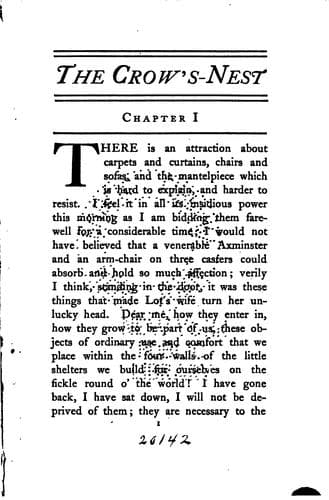
I am more reconciled to my fate when Atma is in the garden, he is
something human to look at and to consider, and he moves with such
calm wisdom among the plants. He has a short black curling beard
that grows almost up to his high cheek-bones, and soft round brown
eyes full of guileless cunning, and a wide and pleasant smile. He
is just a gentle hill-man and by religion a gardener, but with his
turban twisted low and flat over his ears he might be any of the Old
Testament characters one remembers in the pictured Bible stories of
one’s childhood. Something primitive and natural about him binds him
closely to Adam in my mind. It was with this simplicity and patience,
I am sure, that the original cultivator tied up his banksias and saved
his portulaca and mignonette after the fall, when he had something to
do beside come to his meals. I am not the only person; everybody to
whom it is pointed out notices at once how remarkably Atma takes after
the father of us all. I have often wished to call him Adam because of
his so peculiarly deserving it; but Tiglath-Pileser says that profane
persons, knowing that he could not have received the name at his
baptism, might laugh and thus hurt his feelings. So he is Atma still.
It is near enough.
He is also patriarchal in his ideas. This morning he came to us upon
the business of Sropo. Sropo, he said, wished for six days’ leave in
order to marry himself. “But,” said I, “this is not at all proper.
Sropo went away last year to marry himself. How shall Sropo have two
wives?”
“Nā,” replied Atma, with his kindly smile, “that was Masuddi. Masuddi
has now a wife and a son has been,[1] and his wages are so much the
less. Also without doubt this Sropo could not have two wives.”
“Certainly not,” said Tiglath-Pileser, virtuously.
“Sropo is of my village,” Atma explained, genially, “and we folk are
all poor men. More than one wife cannot be taken. But if we were rich
like the Presence,” he went on, gravely, “we would have five or six.”
Tiglath-Pileser shook his head. “You would be sorry,” said he. “It
would be a mistake,” but only I saw the ambiguity in his eye.
“It is not your Honour’s custom,” returned Atma, simply. “Sropo, then,
will go?”
“Call Masuddi,” said Tiglath-Pileser. “It is a serious matter, this of
wives.”
Round the corner of the verandah came Masuddi, shy and broadly smiling,
with an end of his cotton shirt in the corner of his mouth and pulling
at it, as other kinds of children pull at their pinafores.
“Masuddi,” said Tiglath-Pileser, “last year you made a marriage in your
house, and now you have a son. Er--which young woman did you marry?”
Masuddi’s smile broadened; he cast down his eyes and scrabbled the
gravel about with his foot. “Tuktoo,” he said shamefacedly.
“Well, there is no harm in that. What is the name of your son?”
Public-domain text, read in full here on John Shaqi.
Reviews
Reviews
No reviews yet
Be the first to share your thoughts on this work.
Join the Discussion
Join the discussion
Sign in to leave a comment or review.
Sign InorCreate an account