India -- History -- British occupation, 1765-1947 -- Fiction; Invalids -- Fiction; Simla (India) -- Fiction
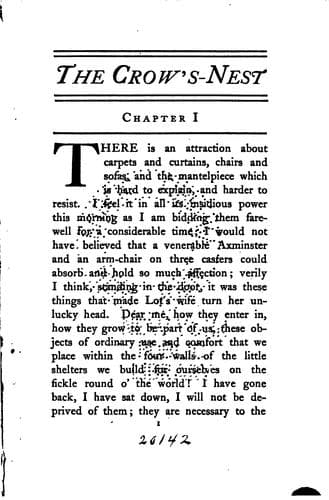
Comfortable persons like, oh several I could mention, who have no way
of walking with another postman’s legs or bending with another coolie’s
back and who cannot understand why this should be called a distressful
world which provides them regularly with tea and muffins, should go on
naturally, to the end. They have their indifferent prototypes among the
vegetables; though I have noticed that most flowers look with the eye
of compassion upon life. They follow the simple lines upon which they
were created, by which to live and not to observe is the chief end of
man; there are a great many of them, thousands, in their protective
skins all over the world; and they are only interesting of course to
each other. Nevertheless no one should speak slightingly of them, for
we all number them among our friends and relations, and constantly
go and stay with them. Besides, I did not set out to be disagreeable
at anybody’s expense. It was only borne in upon me that for us, the
unhappy minority who have two sets of nerves, one for our own use and
one at the disposal of every human failure by the wayside, the world
is not likely to become a pleasanter place the longer one stays in it.
If continual dropping will wear away a stone, continual rubbing will
wear away a skin, and happy is he or she, after sixty or seventy years’
contact with the misery of life, who arrives at the grave with a whole
one.
I do not deny that there are poultices. One of them is a thing
Tiglath-Pileser sometimes says--that it is stupid to talk about the
aggregate of human woe, since all the pain as well as all the pleasure
of the world is summed up in the individual and limited by him. A
battle is really no more than the killing of a soldier, a famine is
comprised in a death by starvation. The unit of experience refuses to
merge in the mass; you cannot multiply beyond one. I do not think much
of this emollient, but such as it is I will apply it if another coolie
comes in with charcoal.
Public-domain text, read in full here on John Shaqi.
Reviews
Reviews
No reviews yet
Be the first to share your thoughts on this work.
Join the Discussion
Join the discussion
Sign in to leave a comment or review.
Sign InorCreate an account