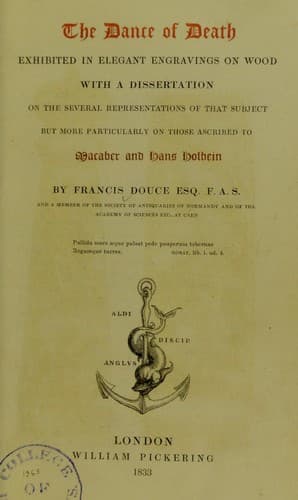
The Dance of Death: Exhibited in Elegant Engravings on Wood with a Dissertation on the Several Representations of that Subject but More Particularly on Those Ascribed to Macaber and Hans HolbeinDouce, Francis
History
The Dance of Death: Exhibited in Elegant Engravings on Wood with a Dissertation on the Several Representations of that Subject but More Particularly on Those Ascribed to Macaber and Hans Holbein
Douce, Francis
Bible. Old Testament -- Illustrations; Dance of death
"Breviarium seu horarium domesticum ad usum Sarum." Paris, F. Byrckman,
1516. Large folio. Three Deaths and three young men.
"Horæ ad usum Romanum." Paris. Thielman Kerver, 1522. 8vo. And again,
1535. 4to.
A Dutch "Horæ." Paris. Thielman Kerver, 1522. 8vo.
"Heures à l'usage de Paris." Thielman Kerver's widow, 1525. 8vo.
"Missale ad usum Sarum." Paris, 1527. Folio. Three horsemen as noblemen,
but without hawks or hounds.
"Enchiridion preclare ecclesie Sarum." Paris. Thielman Kerver, 1528. 32mo.
"Horæ ad usum fratrum predicatorum ordinis S. Dominici." Paris. Thielman
Kerver, 1529. 8vo.
"Horæ ad usum Romanum." Paris. Yolande Bonhomme, widow of T. Kerver, 1531.
8vo.
"Missale ad usum Sarum." Paris. F. Regnault, 1531. Three Deaths only;
different from the others.
"Prayer of Salisbury." Paris. Francois Regnault, 1531, 12mo.
"Horæ ad usum Sarum." Paris. Widow of Thielman Kerver, 1532. 12mo.
"Heures à l'usage de Paris." Francois Regnault, 1535. 12mo.
"Horæ ad usum Romanum." Paris. Gilles Hardouyn, 1537. 18mo. The subject is
different from all the others, and very curiously treated.
"Heures à l'usage de Paris." Thielman Kerver, 1558. 12mo.
"Heures à l'usage de Rome." Paris. Thielman Kerver, 1573. 12mo.
"Heures à l'usage de Paris." Jacques Kerver, 1573. 12mo. And again, 1575.
12mo.
In "The Contemplation of Sinners," printed by Wynkyn de Worde. 4to.
All the above articles are in the collections of the author of this
dissertation.
In an elegant MS. "Horæ," in the Harl. Coll. No. 2917, 12mo. three Deaths
appear to a pope, an emperor, and a king coming out of a church. All the
parties are crowned.
At the end of Desrey's "Macabri speculum choreæ mortuorum," a hermit sees
a vision of a king, a legislator, and a vain female. They are all lectured
by skeletons in their own likenesses.
In a manuscript collection of unpublished and chiefly pious poems of John
Awdeley, a blind poet and canon of the monastery of Haghmon, in
Shropshire, anno 1426, there is one on the "_trois vifs et trois morts_,"
in alliterative verses, and composed in a very grand and terrific style.
NEGRO FIGURE OF DEATH.
In some degree connected with the old painting of the Macaber Dance in the
church-yard of the Innocents at Paris, was that of a black man over a
vaulted roof, constructed by the celebrated N. Flamel, about the year
1390. This is supposed to have perished with the Danse Macabre; but a copy
of the figure has been preserved in some of the printed editions of the
dance. It exhibits a Negro blowing a trumpet, and was certainly intended
as a personification of Death. In one of the oldest of the above editions
he is accompanied with these verses:
CRY DE MORT.
Tost, tost, tost, que chacun savance
Main à main venir a la danse
De Mort, danser la convient,
Tous et a plusieurs nen souvient.
Venez hommes femmes et enfans,
Jeunes et vieulx, petis et grans,
Ung tout seul nen eschapperoit,
Pour mille escuz si les donnoit, &c.
Public-domain text, read in full here on John Shaqi.
Reviews
Reviews
No reviews yet
Be the first to share your thoughts on this work.
Elsewhere in the archive
Join the Discussion
Join the discussion
Sign in to leave a comment or review.
Sign InorCreate an account