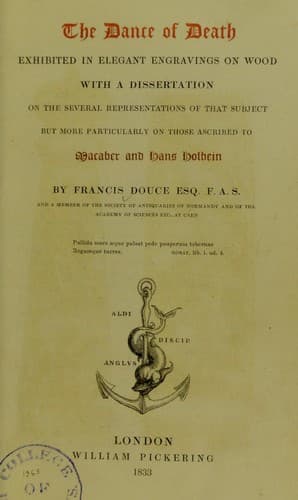
The Dance of Death: Exhibited in Elegant Engravings on Wood with a Dissertation on the Several Representations of that Subject but More Particularly on Those Ascribed to Macaber and Hans HolbeinDouce, Francis
History
The Dance of Death: Exhibited in Elegant Engravings on Wood with a Dissertation on the Several Representations of that Subject but More Particularly on Those Ascribed to Macaber and Hans Holbein
Douce, Francis
Bible. Old Testament -- Illustrations; Dance of death
Before the females in the dance the figure is repeated with a second "Cry
de Mort."
Tost, tost, venez femmes danser
Apres les hommes incontinent,
Et gardez vous bien de verser,
Car vous danserez vrayment;
Mon cornet corne bien souvent
Apres les petis et les grans.
Despecte vous legierement,
Apres la pluye vient le beau temps.
These lines are differently given in the various printed copies of the
Danse Macabre.
This figure is not to be confounded with an alabaster statue of Death that
remained in the church-yard of the Innocents, when it was entirely
destroyed in 1786. It had been usually regarded as the work of Germain
Pilon, but with greater probability belonged to Francois Gentil, a
sculptor at Troyes, about 1540. It was transported to Notre Dame, after
being bronzed and repaired, by M. Deseine, a distinguished artist. It was
saved from the fury of the iconoclast revolutionists by M. Le Noir, and
deposited in the Museum which he so patriotically established in the Rue
des petits Augustins, but it has since disappeared. It was an upright
skeleton figure, holding in one hand a lance which pointed to a shield
with this inscription:
Il n'est vivant, tant soit plein d'art,
Ne de force pour resistance,
Que je ne frappe de mon dart,
Pour bailler aux vers leur pitance.
Priez Dieu pour les trespassés.
It is engraved in the second volume of M. Le Noir's "Musée des monumens
Francais," and also in his "Histoire des arts en France," No. 91.
DANSE AUX AVEUGLES.
There is a poetical work, in some degree connected with the subject of
this dissertation, that ought not to be overlooked. It was composed by
one Pierre Michault, of whom little more seems to be known than that he
was in the service of Charles, Count of Charolois, son of Philip le Bon,
Duke of Burgundy. It is intitled "La Danse aux Aveugles," and the object
of it is to show that all men are subject to the influence of three blind
guides, Love, Fortune, and Death, before whom several persons are
whimsically made to dance. It is a dialogue in a dream between the Author
and Understanding, and the respective blind guides describe themselves,
their nature, and power over mankind, in ten-line stanzas, of which the
following is the first of those which are pronounced by Death:
Je suis la Mort de nature ennemie,
Qui tous vivans finablement consomme,
Anichillant à tous humains la vie,
Reduis en terre et en cendre tout homme.
Je suis la mort qui dure me surnomme,
Pour ce qu'il fault que maine tout affin;
Je nay parent, amy, frere ou affin
Que ne face tout rediger en pouldre,
Et suis de Dieu ad ce commise affin,
Que l'on me doubte autant que tonnant fouldre.
Public-domain text, read in full here on John Shaqi.
Reviews
Reviews
No reviews yet
Be the first to share your thoughts on this work.
Elsewhere in the archive
Join the Discussion
Join the discussion
Sign in to leave a comment or review.
Sign InorCreate an account