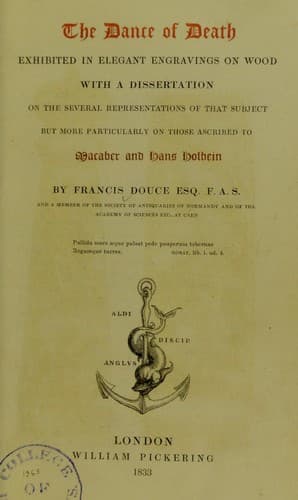
The Dance of Death: Exhibited in Elegant Engravings on Wood with a Dissertation on the Several Representations of that Subject but More Particularly on Those Ascribed to Macaber and Hans HolbeinDouce, Francis
History
The Dance of Death: Exhibited in Elegant Engravings on Wood with a Dissertation on the Several Representations of that Subject but More Particularly on Those Ascribed to Macaber and Hans Holbein
Douce, Francis
Bible. Old Testament -- Illustrations; Dance of death
Some of the editions are ornamented with cuts, in which Death is
occasionally introduced, and that portion of the work which exclusively
relates to him seems to have been separately published, M. Goujet[138]
having mentioned that he had seen a copy in vellum, containing twelve
leaves, with an engraving to every one of the stanzas, twenty-three in
number. More is unnecessary to be added, as M. Peignot has elaborately and
very completely handled the subject in his interesting "Recherches sur les
Danses des Morts." Dijon, 1826. octavo.
CHAPTER XVIII.
_Errors of various writers who have introduced the subject of the
Dance of Death._
To enumerate even a moiety of these mistakes would almost occupy a
separate volume, but it may be as well to notice some of them which are to
be found in works of common occurrence.
TRAVELLERS.--The erroneous remarks of Bishop Burnet and Mr. Coxe have been
already adverted to. See pp. 79, 134, and 138.
Misson seems to regard the old Danse Macabre as the work of Holbein.
The Rev. Robert Gray, in "Letters during the course of a tour through
Germany and Switzerland in the year 1791 and 1792," has stated that Mechel
has engraved _Rubens's designs_ from the Dance of Death, now perishing on
the walls of the church-yard of the Predicant convent, where it was
sketched in 1431.
Mr. Wood, in his "View of the History of Switzerland," as quoted in the
Monthly Review, Nov. 1799, p. 290, states, that "the Dance of Death in the
church-yard of the Predicants has been falsely ascribed to Holbein, as it
is proved that it was painted _long after the death of that artist, and
not before he was born_, as the honourable Horace Walpole supposes." Here
the corrector stands in need himself of correction, unless it be possible
that he is not fairly quoted by the reviewer.
Miss Williams, in her Swiss tour, 1798, when speaking of the Basle Dance
of Death, says it was painted by Kleber, a _pupil of Holbein_.
Those intelligent and amusing travellers, Breval, Keysler, and Blainville
have carefully avoided the above strange mistakes.
WRITERS ON PAINTING AND ENGRAVING.--Meyssens, in his article for Holbein
in "the effigies of the Painters," mentions his "Death's Dance, in the
town-hall of Basle, the design whereof he first neatly cut in wood and
afterwards painted, which appeared so fine to the learned Erasmus, &c."
English edition, 1694, p. 15.
Felibien, in his "Entretiens sur les vies des Peintres," follows Meyssens
as to the painting in the town-hall.
Le Comte places the supposed painting by Holbein in the fish-market, and
in other respects copies Meyssens. "Cabinet des Singularités, &c." tom.
iii. p. 323, edit. 1702, 12mo.
Bullart not only places the painting in the town-hall of Basle, but adds,
that he afterwards engraved it in wood. "Acad. des Sciences et des Arts,"
tom. ii. p. 412.
Public-domain text, read in full here on John Shaqi.
Reviews
Reviews
No reviews yet
Be the first to share your thoughts on this work.
Elsewhere in the archive
Join the Discussion
Join the discussion
Sign in to leave a comment or review.
Sign InorCreate an account