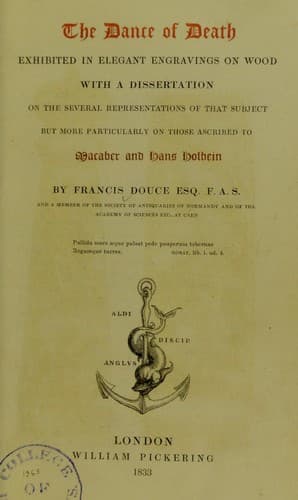
The Dance of Death: Exhibited in Elegant Engravings on Wood with a Dissertation on the Several Representations of that Subject but More Particularly on Those Ascribed to Macaber and Hans Holbein — John Shaqi
The Dance of Death: Exhibited in Elegant Engravings on Wood with a Dissertation on the Several Representations of that Subject but More Particularly on Those Ascribed to Macaber and Hans HolbeinDouce, Francis
History
The Dance of Death: Exhibited in Elegant Engravings on Wood with a Dissertation on the Several Representations of that Subject but More Particularly on Those Ascribed to Macaber and Hans Holbein
Douce, Francis
Bible. Old Testament -- Illustrations; Dance of death
The subject immediately before us was very often represented, not only on
the walls, but in the windows of many churches, in the cloisters of
monasteries, and even on bridges, especially in Germany and Switzerland.
It was sometimes painted on church screens, and occasionally sculptured on
them, as well as upon the fronts of domestic dwellings. It occurs in many
of the manuscript and illuminated service books of the middle ages, and
frequent allusions to it are found in other manuscripts, but very rarely
in a perfect state, as to the number of subjects.
Most of the representations of the Dance of Death were accompanied by
descriptive or moral verses in different languages. Those which were added
to the paintings of this subject in Germany appear to have differed very
materially, and it is not now possible to ascertain which among them is
the oldest. Those in the Basle painting are inserted in the editions
published and engraved by Mathew Merian, but they had already occurred in
the Decennalia humanæ peregrinationis of Gaspar Landismann in 1584. Some
Latin verses were published by Melchior Goldasti at the end of his edition
of the Speculum omnium statuum, a celebrated moral work by Roderic, Bishop
of Zamora, 1613, 4to. He most probably copied them from one of the early
editions of the Danse Macabre, but without any comment whatever, the
above title page professing that they are added on account of the
similarity of the subject.
A Provençal poet, called _Marcabres_ or _Marcabrus_, has been placed among
the versifiers, but none of his works bear the least similitude to the
subject; and, moreover, the language itself is an objection. The English
metrical translation will be noticed hereafter. Whether any of the
paintings were accompanied by descriptive verses that might be considered
as anterior to those ascribed to the supposed Macaber, cannot now be
ascertained.
There are likewise some Latin verses in imitation of those
above-mentioned, which, as well as the author of them, do not seem to have
been noticed by any biographical or poetical writer. They occur at the end
of a Latin play, intitled Susanna, Antverp. apud Michaelem Hillenium,
MDXXXIII. As the volume is extremely rare, and the verses intimately
connected with the present subject, it has been thought worth while to
reprint them. After an elegy on the vanity and shortness of human life,
and a Sapphic ode on the remembrance of Death, they follow under this
title, "Plausus luctificæ mortis ad modum dialogi extemporaliter ab
Eusebio Candido lusus. Ad quem quique mortales invitantur omnes,
cujuscujus sint conditionis: quibusque singulis Mors ipsa respondet."
Luctificæ mortis plausum bene cernite cuncti.
Dum res læta, mori et viventes discite, namque
Omnes ex æquo tandem huc properare necessum.
Hic inducitur adolescens quærens, et mors vel philosophus respondens.
Public-domain text, read in full here on John Shaqi.
Reviews
Reviews
No reviews yet
Be the first to share your thoughts on this work.
Join the Discussion
Join the discussion
Sign in to leave a comment or review.
Sign InorCreate an account