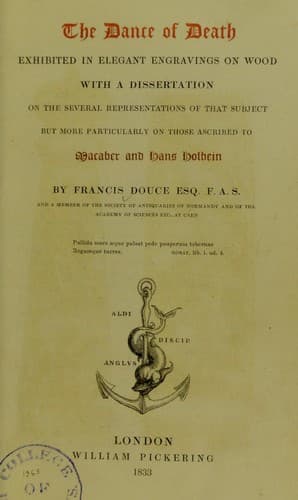
The Dance of Death: Exhibited in Elegant Engravings on Wood with a Dissertation on the Several Representations of that Subject but More Particularly on Those Ascribed to Macaber and Hans HolbeinDouce, Francis
History
The Dance of Death: Exhibited in Elegant Engravings on Wood with a Dissertation on the Several Representations of that Subject but More Particularly on Those Ascribed to Macaber and Hans Holbein
Douce, Francis
Bible. Old Testament -- Illustrations; Dance of death
Hegner next endeavours to annihilate the painting at Whitehall recorded in
Nieuhoff's etchings and dedications, but still by arguments of an entirely
negative kind. He lays much stress on this painting not being specifically
mentioned by Sandrart or Van Mander, who were in England; but where does
it appear that the latter, during his short stay in this country, had
visited Whitehall? Even admitting that both these persons had seen that
palace, it is most probable that the fresco painting of the Dance of
Death, would, from length of time, dampness of the walls, and neglect,
have been in a condition that would not warrant the exhibition of it, and
it was, moreover, placed in a gallery which scarcely formed, at that time,
a part of Whitehall, and which was, probably, not shown to visitors. It
must not, however, be omitted to mention that Sandrart, in p. 239 of his
Acad. Pict. states, though ambiguously, that "there was still remaining at
Whitehall a work by Holbein that would constitute him the Apelles of his
time," an expression which we may remember had been also applied to
Holbein by his friend Borbonius in the complimentary lines on a Dance of
Death.
The Herr Hegner has thought fit to speak of Mr. T. Nieuhoff in terms of
indecorous and unjust contempt, describing him as "an unknown and
unimportant Dutch copper-plate engraver," and arraigning his evidence as
being in manuscript only; as if manuscripts that have never been printed
were of no authority. But where has Hegner discovered that Nieuhoff was a
Dutch copper-plate engraver, by which is meant a professed artist; or even
though he had been such, would that circumstance vitiate his testimony? In
his dedication to Lord William Benting the expressions allusive to his
ardent love of the arts, seem to constitute him an amateur attempter of
etching; for what he has left us in that way is indeed of a very
subordinate character, and unworthy of a professed artist. He appears to
have been one of the Dutchmen who accompanied King William to England, and
to have had apartments assigned to him at Whitehall. At the end of his
dedication to Lord W. Benting, he calls himself an old servant of that
person's father, and subscribes himself "your and your illustrious
family's most obedient and humble servant."
The identification of William Benting must be left to the sagacity of
others. He could not have been the Earl of Portland created in 1689, or he
would have been addressed accordingly. He is, moreover, described as a
youth born at Whitehall, and then residing there, and whose dwelling
consisted of nearly the whole of the palace that remained after the fire.
Public-domain text, read in full here on John Shaqi.
Reviews
Reviews
No reviews yet
Be the first to share your thoughts on this work.
Elsewhere in the archive
Join the Discussion
Join the discussion
Sign in to leave a comment or review.
Sign InorCreate an account