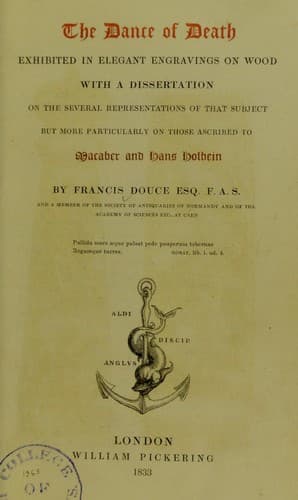
The Dance of Death: Exhibited in Elegant Engravings on Wood with a Dissertation on the Several Representations of that Subject but More Particularly on Those Ascribed to Macaber and Hans HolbeinDouce, Francis
History
The Dance of Death: Exhibited in Elegant Engravings on Wood with a Dissertation on the Several Representations of that Subject but More Particularly on Those Ascribed to Macaber and Hans Holbein
Douce, Francis
Bible. Old Testament -- Illustrations; Dance of death
Again,--We have before us a person living in the palace of Whitehall
anterior to its destruction, testifying what he had himself seen, and
addressing one who could not be imposed upon, as residing also in the
palace. There seems to be no possible motive on the part of Nieuhoff for
stating an untruth, and his most clear and unimpeachable testimony is
opposed by Hegner's wild and weak conjectures, and chiefly by the negative
argument that a few strangers who visited England in a hasty manner have
not mentioned the painting in question at Whitehall, amidst those
inaccurate and superficial accounts of England which, with little
exception, have been given by foreign travellers. Among these Hegner has
selected Patin and Sandrart. Before adducing the former, he would have
done well to have looked at his very imperfect and erroneous account of
Holbein's works, in his edition of the [Greek: MÔRIAS EGKÔMION] of
Erasmus; and, with respect to the latter, the stamp of inaccuracy has been
long affixed to most of the works he has published. He has mentioned, that
being in company with Rubens in a Dutch passage boat "the conversation
fell upon Holbein's book of cuts, representing the Dance of Death; that
Rubens gave them the highest encomiums, advising him, who was then a young
man, to set the highest value upon them, informing him, at the same time,
that he in his youth had copied them."[139] On this passage Mr. Warton has
well remarked that if Rubens styled these prints Holbein's, in familiar
conversation, it was but calling them by the name which the world had
given them, and by which they were generally known; and that Sandrart has,
in another place, confounded them with the Basle painting.[140]
To conclude,--Juvenal's "hoc volo, sic jubeo, sit pro ratione voluntas,"
may be regarded as Herr Hegner's literary motto. He has advocated the
vague traditions of unauthenticated Dances of Death by Holbein, and has
made a most unjustifiable attempt to deprive that truly great artist of
the only painting on the subject which really appears to belong to him.
Yet, if by fair and candid argument, supported by the necessary proofs,
the usual and long standing claim on the part of Holbein can be
substantiated, no one will thereby be more highly gratified than the
author of this dissertation.
ADDITIONS AND CORRECTIONS.
P. 59. After No. 17 add "La Danse Macabre." Paris, Nicole de la Barre,
1523, 4to. with very different cuts, and some characters omitted in former
editions.
Public-domain text, read in full here on John Shaqi.
Reviews
Reviews
No reviews yet
Be the first to share your thoughts on this work.
Elsewhere in the archive
Join the Discussion
Join the discussion
Sign in to leave a comment or review.
Sign InorCreate an account