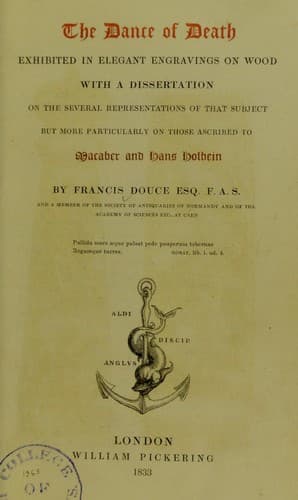
The Dance of Death: Exhibited in Elegant Engravings on Wood with a Dissertation on the Several Representations of that Subject but More Particularly on Those Ascribed to Macaber and Hans HolbeinDouce, Francis
History
The Dance of Death: Exhibited in Elegant Engravings on Wood with a Dissertation on the Several Representations of that Subject but More Particularly on Those Ascribed to Macaber and Hans Holbein
Douce, Francis
Bible. Old Testament -- Illustrations; Dance of death
P. 77, last line of the text. There is a German work intitled "The process
or law-suit of Death," printed, and perhaps written, by Conrad Fyner in
1477; but as it is not noticed in Panzer's list of German books, no
further account of it can be given than that it is briefly mentioned by
Joseph Heller, in a German work on the subject of engraving on wood, in
which one cut from it is introduced, that exhibits Death conversing with a
husbandman who holds a flail in one of his hands. It is probable that the
book would be found to contain other figures relating to a Macaber Dance.
P. 112, l. ult. There is another work by Glissenti, intitled "La Morte
innamorata." Venet. 1608, 24mo. with a dedication to Sir Henry Wotton, the
English ambassador at Venice, by Elisabetta Glissenti Serenella, the
author's niece; in which, after stating that Sir Henry had seen it
represented, she adds, that she had ventured to have it printed for the
purpose of offering it to him as a very humble donation, &c. It is a
moral, dramatic, and allegorical fable of five acts, in which _Man_, to
avoid _Death_, who has fallen in love with him, retires with his family to
the country of _Long Life_, where he takes up his abode in the house of
_the World_, by whom and his wife _Fraud_, who is in strict friendship
with _Fortune_, he is apparently made much of, and calculates on being
very happy. _Death_ follows the _Man_, and being unknown in the above
region, contrives, with the aid of _Infirmity_, the _Man's_ nurse, to make
him fall sick. The _World_ being tired of his guest, and very desirous to
get rid of, and plunder him of his property, under pretence of introducing
him to _Fortune_, and consequent happiness, enters into a plot with _Time_
to disguise _Death_, who is lodged in the same house with him, as
_Fortune_, and thus to give him possession of the _Man_, who imagines that
he is just about to secure _Fortune_. Each act of this piece is ornamented
with some wood-cut that had been already introduced into the other work of
Glissenti.
P. 118, line 32. Ebert, in his "Bibliographisches Lexicon," Leipsig. 1821,
4to. has mentioned some later editions of Denneker's engravings. See the
article Denecker, p. 972.
P. 126, l. 14. It is not impossible that Hollar may have copied a bust
carved in wood, or some other material, by Holbein, as Albert Durer and
other great artists are known to have practised sculpture in this manner.
P. 135, l. 25. These four prints are in the author's possession.
P. 137, l. ult. Other imitations of the Lyons cuts are, 1. A wood
engraving of Adam digging and Eve spinning, by Corn. Van Sichem in the
"Bibel's tresor," Amst. 1646, 4to. 2. The Astrologer, a small circular
print on copper by Le Blond. 3. The Bridegroom, an anonymous modern
engraving on wood. 4. The Miser, a small modern and anonymous print on
copper.
Public-domain text, read in full here on John Shaqi.
Reviews
Reviews
No reviews yet
Be the first to share your thoughts on this work.
Elsewhere in the archive
Join the Discussion
Join the discussion
Sign in to leave a comment or review.
Sign InorCreate an account