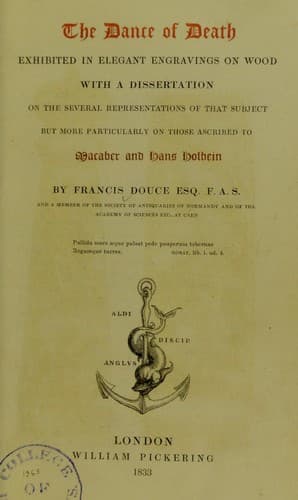
The Dance of Death: Exhibited in Elegant Engravings on Wood with a Dissertation on the Several Representations of that Subject but More Particularly on Those Ascribed to Macaber and Hans HolbeinDouce, Francis
History
The Dance of Death: Exhibited in Elegant Engravings on Wood with a Dissertation on the Several Representations of that Subject but More Particularly on Those Ascribed to Macaber and Hans Holbein
Douce, Francis
Bible. Old Testament -- Illustrations; Dance of death
P. 147, l. 19. In the library at Lambeth palace, No. 1049, there is a copy
of this book in Greek, Latin, Italian, Spanish, English, and French,
printed by J. Day, 1569, 8vo. It was given by Archb. Tillotson, and from a
memorandum in it supposed to have been the Queen's own copy. The cut of
the Queen kneeling was used so late as 1652, in Benlowes' Theophila. Some
of the cuts have the unexplained mark [monogram: CI].
P. 164, Article xii. This print is a copy, with a few variations, of a
much older one engraved on wood, and probably unique, in the very curious
collection of single sheets and black letter ballads, belonging to George
Daniel, Esquire, of Islington. The figures are executed in a style of
considerable merit, and each of them is described in a stanza of four
lines. It may probably be the same as No. 1 or No. 2, mentioned in p. 76,
or either of Nos. x. or xi. described in p. 163.
P. 226, line 12. Another drawing by Rowlandson, intitled "Death and the
Drunkards." Five topers are sitting at a table and enjoying their punch.
Death suddenly enters and violently seizes one of them. Another perceives
the unwelcome and terrific intruder, whilst the rest are too intent on
their liquor to be disturbed at the moment. It is a very spirited and
masterly performance. 11 by 9. In the author's possession.
P. 239, l. 12. There is likewise in the "Biographie Universelle" an
article intitled "Macaber, poete Allemand" by M. Weiss, and it is to be
regretted that a writer whose learning and research are so eminently
conspicuous in many of the best lives in the work, should have permitted
himself to be misled in much that he has said, by the errors of
Champollion Figeac in the Magazin Encyclopedique. He certainly doubts the
existence of Macaber as a writer, but inclines to M. Van Praet's Arabic
_Magbarah_. He states, that the English version of the Macaber Dance
belongs to John Porey, _a poet who remains unknown even to his
countrymen_, and is inserted in the Monasticon Anglicanum. Now this
_unknown poet_, who is likewise adopted by M. Peignot, is merely the
person who contributed Hollar's plate in the Monasticon, already mentioned
in p. 52, and whose coat of arms is at the top of that plate, with the
following inscription, "Quo præsentes et posteri Mortis, ut vidimus, omni
Ordini comunis, sint magis memores, posuit IOHANNES POREY." Mr. Weiss has
likewise inadvertently adopted the error that Holbein painted the old
Dance of Macaber in the convent of the Augustines at Basle.
Two recently published Dances of Death have come to hand too late to have
been noticed in their proper places.
1. "Der Todtentantz. Ein Gedicht von Ludwig Bechstein, mit 48 kupfern in
treuen Conturen nach H. Holbein. Leipzig bei Friedrich August Leo, 1831."
8vo. These prints are executed in a faithful and elegant outline, and
accompanied with modern German verses.
Public-domain text, read in full here on John Shaqi.
Reviews
Reviews
No reviews yet
Be the first to share your thoughts on this work.
Elsewhere in the archive
Join the Discussion
Join the discussion
Sign in to leave a comment or review.
Sign InorCreate an account