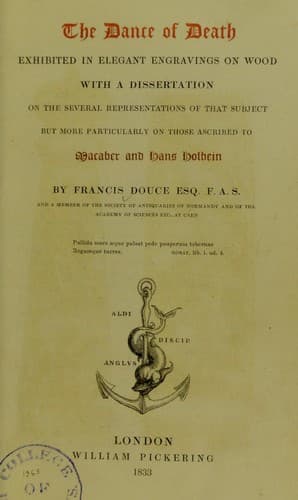
The Dance of Death: Exhibited in Elegant Engravings on Wood with a Dissertation on the Several Representations of that Subject but More Particularly on Those Ascribed to Macaber and Hans HolbeinDouce, Francis
History
The Dance of Death: Exhibited in Elegant Engravings on Wood with a Dissertation on the Several Representations of that Subject but More Particularly on Those Ascribed to Macaber and Hans Holbein
Douce, Francis
Bible. Old Testament -- Illustrations; Dance of death
2. "Hans Holbein's Todtentanz in 53 getreu nach den Holz schnitten
lithographirten Blattern. Heraus gegeben von J. Schlotthaver k. Professor
Mit erklärendem Texte. Munchen, 1832, Auf Rosten des Heraus gegebers."
12mo. The prints are most accurately and elegantly lithographed in
imitation of wood engraving. The descriptions are in German verse, and
accompanied with some brief prefatory matter by Dr. H. F. Massmann, which
is said to have been amplified in one of the German journals or reviews.
DESCRIPTION OF THE CUTS GIVEN IN THE DISSERTATION.
I. The frontispiece is a design for the sheath of a dagger, probably made
by Holbein for the use of a goldsmith or chaser. The original drawing is
in the public library at Basle. See some remarks on it in p. 133.
II. These circular engravings by Israel Van Meckenen are mentioned in p.
160.
III. Copy of an ancient drawing, 1454, of Death and the Beggar. See p.
223.
IV. Figures of Death and the Lady, sculptured on a monument of the
Delawars, in Boxgrove church, Sussex. See p. 226.
V. A fac-simile of one of the cuts to a very early edition, printed
without date at Troyes by Nicolas le Rouge. It represents the story of the
_trois morts et trois vifs_, and the vision of Saint Macarius. See pp. 33,
34, and 59.
VI. A fac-simile of another cut from the edition of a Danse Macabre,
mentioned in No. V.
DESCRIPTION OF THE LYONS WOOD-CUTS OF THE DANCE OF DEATH.
_The Copies have been made by MR. BONNER from the Cuts belonging to
the "Imagines Mortis, Lugduni sub scuto Coloniensi, 1547," 12mo. and
which have been usually ascribed to Holbein._
1. THE CREATION OF ALL THINGS. The Deity is seen taking Eve from the side
of Adam. "Formavit Dominus Deus hominem de limo terræ, &c." Gen. i.
2. THE TEMPTATION. Eve has just received the forbidden fruit from the
serpent, who, on the authority of venerable Bede, is here, as well as in
most ancient representations of the subject, depicted with a female human
face. She holds it up to Adam, and entices him to gather more of it from
the tree. "Quia audisti vocem uxoris tuæ, et comedisti de ligno, &c." Gen.
iii.
3. THE EXPULSION FROM PARADISE. Adam and Eve are preceded by Death, who
plays on a vielle, or beggar's lyre, as if demonstrating his joy at the
victory he has obtained over man. "Emisit eum Dominum Deus de Paradiso
voluptatis, ut operaretur terram de qua sumptus est." Gen. iii.
4. THE CONSEQUENCES OF THE FALL OF MAN. Adam is digging the ground,
assisted by Death. In the distance Eve is suckling her first-born and
holding a distaff. Whence the proverb in many languages:
When Adam delv'd and Eve span
Where was then the gentleman?
"Maledicta terra in opere tuo, in laboribus comedes cunctis diebus vitæ
tuæ, donec revertaris, &c." Gen. iii.
5. A CEMETERY, in which several Deaths are assembled, most of whom are
playing on noisy instruments of music, as a general summons to mortals to
attend them. "Væ, væ, væ habitantibus in terra." Apoc. viii.
Public-domain text, read in full here on John Shaqi.
Reviews
Reviews
No reviews yet
Be the first to share your thoughts on this work.
Elsewhere in the archive
Join the Discussion
Join the discussion
Sign in to leave a comment or review.
Sign InorCreate an account