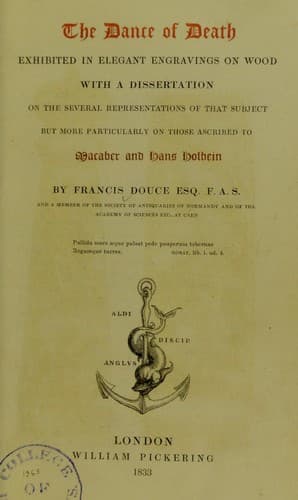
The Dance of Death: Exhibited in Elegant Engravings on Wood with a Dissertation on the Several Representations of that Subject but More Particularly on Those Ascribed to Macaber and Hans HolbeinDouce, Francis
History
The Dance of Death: Exhibited in Elegant Engravings on Wood with a Dissertation on the Several Representations of that Subject but More Particularly on Those Ascribed to Macaber and Hans Holbein
Douce, Francis
Bible. Old Testament -- Illustrations; Dance of death
6. THE POPE. He is crowning an Emperor, who kneels before him, two
Cardinals attending, one of whom is ludicrously personated by Death. In
the back-ground are bishops, &c. Death embraces the Pope with one hand,
and with the other leans on a crutch. Two grotesque Devils are introduced
into the cut, one of whom hovers over the Pope, the other in the air holds
a diploma, to which several seals are appended. "Moriatur sacerdos
magnus." Josue xx.
7. THE EMPEROR. Seated on a throne, and attended by his courtiers, he
seems to be listening to, or deciding, the complaint of a poor man who is
kneeling before him, against his rich oppressor, whom the Emperor, holding
the sword of justice, seems to regard with an angry countenance. Behind
him Death lays hands upon his crown. "Dispone domui tuæ, morieris, enim
tu, et non vives." Isaiæ xxxviii.
8. THE KING. He is sitting at his repast before a well-covered table,
under a canopy studded with fleurs-de-lis. Death intrudes himself as a
cupbearer, and presents the King with probably his last draught. The
figure of the King seems intended as a portrait of Francis I. "Sicut et
Rex hodie est, et cras morietur; nemo enim ex regibus aliud habuit."
Ecclesiast. x. et Sapient. vii.
9. THE CARDINAL. There is some difficulty in ascertaining the real meaning
of the designer of this subject. It has been described as the Cardinal
receiving the bull of his appointment, or as a rich man making a purchase
of indulgences. The latter interpretation seems warranted by the Latin
motto. Death is twisting off the Cardinal's hat. "Væ qui justificatis
impium pro muneribus, et justitiam justi aufertis ab eo." Isaiæ v.
10. THE EMPRESS. Gorgeously attired and attended by her maids of honour,
she is intercepted in her walk by Death in the character of a shrivelled
old woman, who points to an open grave, and seems to say, "to this you
must come at last." "Gradientes in superbia potest Deus humiliare." Dan.
iv.
11. THE QUEEN. She has just issued from her palace, when Death
unexpectedly appears and forcibly drags her away. Her jester, in whose
habiliments Death has ludicrously attired himself, endeavours in vain to
protect his mistress. A female attendant is violently screaming. Death
holds up his hour-glass to indicate the arrival of the fatal hour.
"Mulieres opulentæ surgite, et audite vocem meam: post dies et annum, et
vos conturbemini." Isaiæ xxxii.
12. THE BISHOP. Quietly resigned to his fate he is led away by Death,
whilst the loss of the worthy Pastor is symbolically deplored by the
flight and terror of several shepherds in the distance amidst their
flocks. The setting sun is very judiciously introduced. "Percutiam
pastorem, et dispergentur oves gregis." Mat. xxvi. Mar. xiv.
Public-domain text, read in full here on John Shaqi.
Reviews
Reviews
No reviews yet
Be the first to share your thoughts on this work.
Elsewhere in the archive
Join the Discussion
Join the discussion
Sign in to leave a comment or review.
Sign InorCreate an account