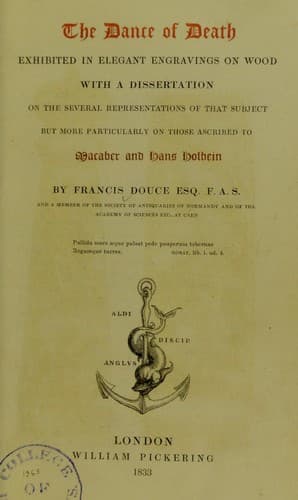
The Dance of Death: Exhibited in Elegant Engravings on Wood with a Dissertation on the Several Representations of that Subject but More Particularly on Those Ascribed to Macaber and Hans HolbeinDouce, Francis
History
The Dance of Death: Exhibited in Elegant Engravings on Wood with a Dissertation on the Several Representations of that Subject but More Particularly on Those Ascribed to Macaber and Hans Holbein
Douce, Francis
Bible. Old Testament -- Illustrations; Dance of death
13. THE DUKE. Attended by his courtiers, he is accosted in the street for
charity by a poor beggar woman with her child. He disdainfully turns aside
from her supplication, whilst Death, fantastically crowned with leaves,
unexpectedly lays violent hands upon him. "Princeps induetur moerore, et
quiescere faciam superbiam potentium." Ezech. viii.
14. THE ABBOT. Death having despoiled him of his mitre and crosier, drags
him away. The Abbot resists with all his might, and is about to throw his
breviary at his adversary. "Ipse morietur, quia non habuit disciplinam,
et in multitudine stultitiæ suæ decipietur."
15. THE ABBESS. Death, grotesquely crowned with flags, seizes the poor
Abbess by her scapulary. A Nun at the convent gate, with uplifted hands,
bewails the fate of her superior. "Laudavi magis mortuos quam viventes."
Eccles. iv.
16. THE GENTLEMAN. He vainly, with uplifted sword, endeavours to liberate
himself from the grasp of Death. The hour-glass is placed on his bier.
"Quis est homo qui vivet, et non videbit mortem, eruet animam suam de manu
inferi?"
17. THE CANON. Death holds up his hour-glass to him as he is entering a
cathedral. They are followed by a noble person with a hawk on his fist,
his buffoon or jester, and a little boy. "Ecce appropinquat hora." Mat.
xxvi.
18. THE JUDGE. He is deciding a cause between a rich and a poor man. From
the former he is about to receive a bribe. Death behind him snatches his
staff of office from one of his hands. "Disperdam judicem de medio ejus."
Amos ii.
19. THE ADVOCATE. The rich client is putting a fee into the hands of the
dishonest lawyer, to which Death also contributes, but reminds him at the
same time that his glass is run out. To this admonition he seems to pay
little regard, fully occupied in counting the money. Behind this group is
the poor suitor, wringing his hands, and lamenting that his poverty
disables him from coping with his wealthy adversary. "Callidus vidit
malum, et abscondit se: innocens pertransiit, et afflictus est damno."
Prover. xxii.
20. THE MAGISTRATE. A Demon is blowing corruption into the ear of a
magistrate, who has turned his back on a poor man, whilst he is in close
conversation with another person, to whose story he seems emphatically
attentive. Death at his feet with an hour-glass and spade. "Qui obturat
aurem suam ad clamorem pauperis, et ipse clamabit, et non exaudietur."
Prover. xxi.
21. THE PREACHER. Death with a stole about his neck stands behind the
preacher, and holds a jaw-bone over his head, typifying perhaps thereby
that he is the best preacher of the two. "Væ qui dicitis malum bonum, et
bonum malum: ponentes tenebras lucem, et lucem tenebras: ponentes amarum
in dulce, et dulce in amarum." Isaiæ v.
Public-domain text, read in full here on John Shaqi.
Reviews
Reviews
No reviews yet
Be the first to share your thoughts on this work.
Elsewhere in the archive
Join the Discussion
Join the discussion
Sign in to leave a comment or review.
Sign InorCreate an account