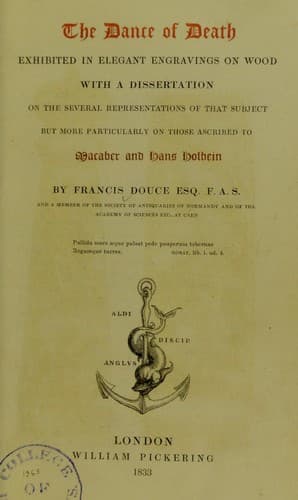
The Dance of Death: Exhibited in Elegant Engravings on Wood with a Dissertation on the Several Representations of that Subject but More Particularly on Those Ascribed to Macaber and Hans HolbeinDouce, Francis
History
The Dance of Death: Exhibited in Elegant Engravings on Wood with a Dissertation on the Several Representations of that Subject but More Particularly on Those Ascribed to Macaber and Hans Holbein
Douce, Francis
Bible. Old Testament -- Illustrations; Dance of death
A very early allusion to the Dance of Death occurs in a Latin poem, that
seems to have been composed in the twelfth century by our celebrated
countryman Walter de Mapes, as it is found among other pieces that carry
with them strong marks of his authorship. It is intitled "Lamentacio et
deploracio pro Morte et consilium de vivente Deo."[37] In its construction
there is a striking resemblance to the common metrical stanzas that
accompany the Macaber Dance. Many characters, commencing with that of the
Pope, are introduced, all of whom bewail the uncontrolable influence of
Death. This is a specimen of the work, extracted from two manuscripts:
Cum mortem meditor nescit mihi causa doloris,
Nam cunctis horis mors venit ecce cito.
Pauperis et regis communis lex moriendi,
Dat causam flendi si bene scripta leges.
Gustato pomo missus transit sine morte
Heu missa sorte labitur omnis homo.
Vado mori Papa qui jussu regna | Vado mori, Rex sum, quod honor,
subegi | quod gloria regum,
Mors mihi regna tulit eccine vado | Est via mors hominis regia vado
mori. | mori.
Then follow similar stanzas, for presul, miles, monachus, legista,
jurista, doctor, logicus, medicus, cantor, sapiens, dives, cultor,
burgensis, nauta, pincerna, pauper.
In Sanchez's collection of Spanish poetry before the year 1400,[38]
mention is made of a Rabbi Santo as a good poet, who lived about 1360. He
was a Jew, and surgeon to Don Pedro. His real name seems to have been
Mose, but he calls himself Don Santo Judio de Carrion. This person is said
to have written a moral poem, called "Danza General." It commences thus:
"_Dise la Muerte._
"Yo so la muerte cierta a todas criaturas,
Que son y seran en el mundo durante:
Demando y digo O ame! porque curas
De vida tan breve en punto passante?" &c.
He then introduces a preacher, who announces Death to all persons, and
advises them to be prepared by good works to enter his Dance, which is
calculated for all degrees of mankind.
"Primaramente llama a su danza a dos doncellas,
A esta mi danza trax de presente,
Estas dos donzellas que vades fermosas:
Ellas vinieron de muy malamente
A oir mes canciones que son dolorosas,
Mas non les valdran flores nin rosas,
Nin las composturas que poner salian:
De mi, si pudiesen parterra querrian,
Mas non proveda ser, que son mis esposas."
It may, however, be doubted whether the Jew Santo was the author of this
Dance of Death, as it is by no means improbable that it may have been a
subsequent work added to the manuscript referred to by Sanchez.
Public-domain text, read in full here on John Shaqi.
Reviews
Reviews
No reviews yet
Be the first to share your thoughts on this work.
Join the Discussion
Join the discussion
Sign in to leave a comment or review.
Sign InorCreate an account