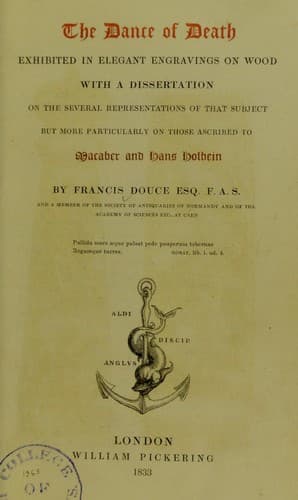
The Dance of Death: Exhibited in Elegant Engravings on Wood with a Dissertation on the Several Representations of that Subject but More Particularly on Those Ascribed to Macaber and Hans HolbeinDouce, Francis
History
The Dance of Death: Exhibited in Elegant Engravings on Wood with a Dissertation on the Several Representations of that Subject but More Particularly on Those Ascribed to Macaber and Hans Holbein
Douce, Francis
Bible. Old Testament -- Illustrations; Dance of death
In the latest and best edition of some new designs for a Dance of Death,
by Salomon Van Rusting, published by John George Meintel at Nuremberg,
1736, 8vo. there is an elaborate preface by him, with a greater portion of
verbosity than information. He has placed undue confidence in his
predecessor, Paul Christian Hilscher, whose work, printed at Dresden in
1705, had probably misled the truly learned Fabricius in what he has said
concerning Macaber in his valuable work, the "Bibliotheca mediæ et infimæ
ætatis." Meintel confesses his inability to point out the origin or the
inventor of the subject. The last and completest work on the Dance, or
Dances of Death, is that of the ingenious M. Peignot, so well and
deservedly known by his numerous and useful books on bibliography. To this
gentleman the present Essay has been occasionally indebted. He will,
probably, at some future opportunity, remove the whimsical misnomer in his
engraving of Death and the Ideot.
The usual title, "The Dance of Death," which accompanies most of the
printed works, is not altogether appropriate. It may indeed belong to the
old Macaber painting and other similar works where Death is represented in
a sort of dancing and grotesque attitude in the act of leading a single
character; but where the subject consists of several figures, yet still
with occasional exception, they are rather to be regarded as elegant
emblems of human mortality in the premature intrusion of an unwelcome and
inexorable visitor.
It must not be supposed that the republication of this singular work is
intended to excite the lugubrious sensations of sanctified devotees, or of
terrified sinners; for, awful and impressive as must ever be the
contemplation of our mortality in the mind of the philosopher and
practiser of true religion, the mere sight of a skeleton cannot, as to
them, excite any alarming sensation whatever. It is chiefly addressed to
the ardent admirers of ancient art and pictorial invention; but
nevertheless with a hope that it may excite a portion of that general
attention to the labours of past ages, which reflects so much credit on
the times in which we live.
The widely scattered materials relating to the subject of the Dance of
Death, and the difficulty of reconciling much discordant information, must
apologize for a few repetitions in the course of this Essay, the regular
progress of which has been too often interrupted by the manner in which
matter of importance is so obscurely and defectively recorded; instances
of which are, the omission of the name of the painter in the otherwise
important dedication to the first edition of the engravings on wood of the
Dance of Death that was published at Lyons; the uncertainty as to locality
in some complimentary lines to Holbein by his friend Borbonius, and the
want of more particulars in the account by Nieuhoff of Holbein's painting
at Whitehall.
Public-domain text, read in full here on John Shaqi.
Reviews
Reviews
No reviews yet
Be the first to share your thoughts on this work.
Join the Discussion
Join the discussion
Sign in to leave a comment or review.
Sign InorCreate an account