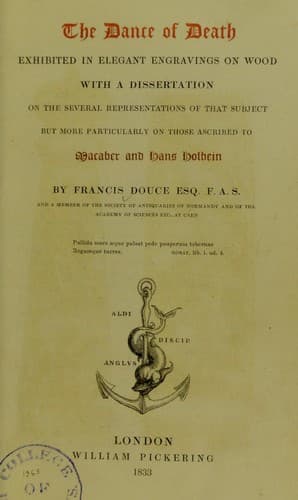
The Dance of Death: Exhibited in Elegant Engravings on Wood with a Dissertation on the Several Representations of that Subject but More Particularly on Those Ascribed to Macaber and Hans Holbein — John Shaqi
The Dance of Death: Exhibited in Elegant Engravings on Wood with a Dissertation on the Several Representations of that Subject but More Particularly on Those Ascribed to Macaber and Hans HolbeinDouce, Francis
History
The Dance of Death: Exhibited in Elegant Engravings on Wood with a Dissertation on the Several Representations of that Subject but More Particularly on Those Ascribed to Macaber and Hans Holbein
Douce, Francis
Bible. Old Testament -- Illustrations; Dance of death
In the course of the thirteenth century there appeared a French metrical
work under the name of "Li trois Mors et li trois Vis," _i. e._ Les trois
Morts et les trois Vifs. In the noble library of the Duke de la Valliere,
there were three apparently coeval manuscripts of it, differing, however,
from each other, but furnishing the names of two authors, Baudouin de
Condé and Nicolas de Marginal.[48] These poems relate that three noble
youths when hunting in a forest were intercepted by the like number of
hideous spectres or images of Death, from whom they received a terrific
lecture on the vanity of human grandeur. A very early, and perhaps the
earliest, allusion to this vision, seems to occur in a painting by Andrew
Orgagna in the Campo Santo at Pisa; and although it varies a little from
the description in the above-mentioned poems, the story is evidently the
same. The painter has introduced three young men on horseback with
coronets on their caps, and who are attended by several domestics whilst
pursuing the amusement of hawking. They arrive at the cell of Saint
Macarius an Egyptian Anachorite, who with one hand presents to them a
label with this inscription, as well as it can be made out, "Se nostra
mente fia ben morta tenendo risa qui la vista affitta la vana gloria ci
sara sconfitta la superbia e sara da morte;" and with the other points to
three open coffins, in which are a skeleton and two dead bodies, one of
them a king.
A similar vision, but not immediately connected with the present subject,
and hitherto unnoticed, occurs at the end of the Latin verses ascribed to
Macaber, in Goldasti's edition of the Speculum omnium statuum à Roderico
Zamorensi. Three persons appear to a hermit, whose name is not mentioned,
in his sleep. The first is described as a man in a regal habit; the second
as a civilian, and the third as a beautiful female decorated with gold and
jewels. Whilst these persons are vainly boasting of their respective
conditions, they are encountered by three horrible spectres in the shape
of dead human bodies covered with worms, who very severely reprove them
for their arrogance. This is evidently another version of the "Trois mors
et trois vifs" in the text, but whether it be older or otherwise cannot
easily be ascertained. It is composed in alternate rhymes, in the manner,
and probably by the author of Philibert or Fulbert's vision of the dispute
between the soul and the body, a work ascribed to S. Bernard, and
sometimes to Walter de Mapes. There are translations of it both in French
and English.
[Illustration]
[Illustration]
Public-domain text, read in full here on John Shaqi.
Reviews
Reviews
No reviews yet
Be the first to share your thoughts on this work.
Join the Discussion
Join the discussion
Sign in to leave a comment or review.
Sign InorCreate an account