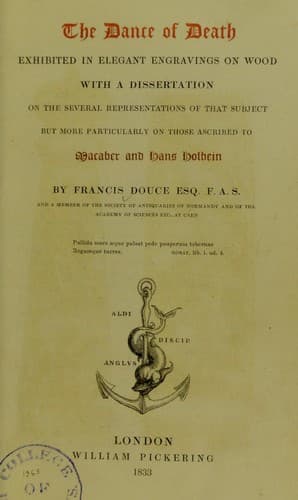
The Dance of Death: Exhibited in Elegant Engravings on Wood with a Dissertation on the Several Representations of that Subject but More Particularly on Those Ascribed to Macaber and Hans HolbeinDouce, Francis
History
The Dance of Death: Exhibited in Elegant Engravings on Wood with a Dissertation on the Several Representations of that Subject but More Particularly on Those Ascribed to Macaber and Hans Holbein
Douce, Francis
Bible. Old Testament -- Illustrations; Dance of death
The next Macaber Dance, in point of date, was the celebrated one at
Basle, which has employed the pens and multiplied the errors of many
writers and travellers. It was placed under cover in a sort of shed in the
church-yard of the Dominican convent. It has been remarked by one very
competent to know the fact, that nearly all the convents of the Dominicans
had a Dance of Death.[54] As these friars were preachers by profession,
the subject must have been exceedingly useful in supplying texts and
matter for their sermons. The present Dance is said to have been painted
at the instance of the prelates who assisted at the Grand Council of
Basle, that lasted from 1431 to 1443; and in allusion, as supposed, to a
plague that happened during its continuance. Plagues have also been
assigned as the causes of other Dances of Death; but there is no
foundation whatever for such an opinion, as is demonstrable from what has
been already stated; and it has been also successfully combated by M.
Peignot, who is nevertheless a little at variance with himself, when he
afterwards introduces a conjecture that the painter of the first Dance
imitated the violent motions and contortions of those affected by the
plague in the dancing attitudes of the figures of Death.[55] The name of
the original painter of this Basle work is unknown, and will probably ever
remain so, for no dependance can be had on some vague conjectures, that
without the smallest appearance of accuracy have been hazarded concerning
it. It is on record that the old painting having become greatly injured by
the ravages of time, John Hugh Klauber, an eminent painter at Basle, was
employed to repair it in the year 1568, as appears from a Latin
inscription placed on it at the time. This painter is said to have covered
the decayed fresco with oil, and to have succeeded so well that no
difference between his work and the original could be perceived. He was
instructed to add the portrait of the celebrated Oecolampadius in the act
of preaching, in commemoration of his interference in the Reformation,
that had not very long before taken place. He likewise introduced at the
end of the painting, portraits of himself, his wife Barbara Hallerin, and
their little son Hans Birich Klauber. The following inscription, placed on
the painting on this occasion, is preserved in Hentzner's Itinerary, and
elsewhere.
A. O. C.
Sebastiano Doppenstenio, Casparo Clugio Coss.
Bonaventura à Bruno, Jacobo Rudio Tribb. Pl.
Hunc mortales chorum fabulæ, temporis injuria vitiatum
Lucas Gebhart, Iodoc. Pfister. Georgius Sporlinus
Hujus loci Ædiles.
Integritati suæ restituendum curavere
Ut qui vocalis picturæ divina monita securius audiunt
Mutæ saltem poëseos miserab. spectaculo
Ad seriam philosophiam excitentur.
[Greek: ORATELOS MAKROU BIOU
ARCHÊN ORAMAKARIOU]
CI=C= I=C= LXIIX.
Public-domain text, read in full here on John Shaqi.
Reviews
Reviews
No reviews yet
Be the first to share your thoughts on this work.
Join the Discussion
Join the discussion
Sign in to leave a comment or review.
Sign InorCreate an account