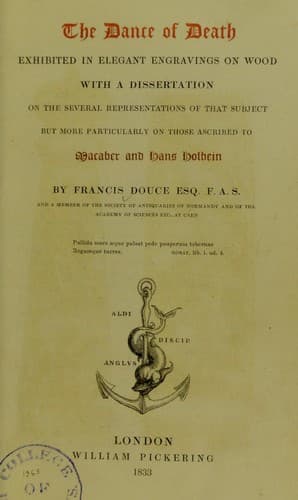
The Dance of Death: Exhibited in Elegant Engravings on Wood with a Dissertation on the Several Representations of that Subject but More Particularly on Those Ascribed to Macaber and Hans Holbein — John Shaqi
The Dance of Death: Exhibited in Elegant Engravings on Wood with a Dissertation on the Several Representations of that Subject but More Particularly on Those Ascribed to Macaber and Hans HolbeinDouce, Francis
History
The Dance of Death: Exhibited in Elegant Engravings on Wood with a Dissertation on the Several Representations of that Subject but More Particularly on Those Ascribed to Macaber and Hans Holbein
Douce, Francis
Bible. Old Testament -- Illustrations; Dance of death
In the year 1616 a further reparation took place, and some alterations in
the design are said to have been then made. The above inscription, with an
addition only of the names of the then existing magistrates of the city,
was continued. A short time before, Mathew Merian the elder, a celebrated
topographical draftsman, had fortunately copied the older painting, of
which he is supposed to have first published engravings in 1621, with all
the inscriptions under the respective characters that were then remaining,
but these could not possibly be the same in many respects that existed
before the Reformation, and which are entirely lost. A proof of this may
be gathered from the lines of the Pope's answer to Death, whom he is thus
made to apostrophize: "Shall it be said that I, a God upon earth, a
successor of St. Peter, a powerful prince, and a learned doctor, shall
endure thy insolent summons, or that, in obedience to thy decree, I should
be compelled to ascertain whether the keys which I now possess will open
for me the gates of Paradise?" None of the inscriptions relating to the
Pope in other ancient paintings before the Reformation approach in the
least to language of this kind.
Merian speaks of a tradition that in the original painting the portrait of
Pope Felix V. was introduced, as well as those of the Emperor Sigismund
and Duke Albert II. all of whom were present at the council; but admitting
this to have been the fact, their respective features would scarcely
remain after the subsequent alterations and repairs that took place.
That intelligent traveller, Mons. Blainville, saw this painting in
January, 1707. He states that as it had been much injured by the weather,
and many of the figures effaced, the government caused it to be retouched
by a painter, whom they imagined to be capable of repairing the ravages it
had sustained, but that his execution was so miserable that they had much
better have let it alone than to have had it so wretchedly bungled. He
wholly rejects any retouching by Holbein. He particularizes two of the
most remarkable subjects, namely, the fat jolly cook, whom Death seizes by
the hand, carrying on his shoulder a spit with a capon ready larded, which
he looks upon with a wishful eye, as if he regretted being obliged to set
out before it was quite roasted. The other figure is that of the blind
beggar led by his dog, whom Death snaps up with one hand, and with the
other cuts the string by which the dog was tied to his master's arm.[56]
Public-domain text, read in full here on John Shaqi.
Reviews
Reviews
No reviews yet
Be the first to share your thoughts on this work.
Join the Discussion
Join the discussion
Sign in to leave a comment or review.
Sign InorCreate an account