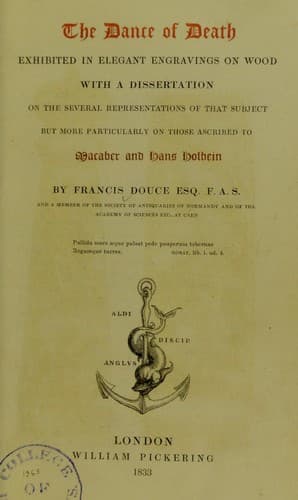
The Dance of Death: Exhibited in Elegant Engravings on Wood with a Dissertation on the Several Representations of that Subject but More Particularly on Those Ascribed to Macaber and Hans HolbeinDouce, Francis
History
The Dance of Death: Exhibited in Elegant Engravings on Wood with a Dissertation on the Several Representations of that Subject but More Particularly on Those Ascribed to Macaber and Hans Holbein
Douce, Francis
Bible. Old Testament -- Illustrations; Dance of death
Of this Dance of Death very few specific copies have been made. M.
Heinecken[58] has stated that it was engraved in 1544, by Jobst Denneker
of Augsburg; but he has confounded it with a work by this artist on the
other Dance of Death ascribed to Holbein, and which will be duly noticed
hereafter. The work which contained the earliest engravings of the Basle
painting, can on this occasion be noticed only from a modern reprint of it
under the following title: "Der Todten-Tantz wie derselbe in der
weitberuhmten Stadt Basel als ein Spiegel menslicher beschaffenheit gantz
kuntlich mit lebendigen farben gemahlet, nicht ohne nutzliche vernunderung
zu schen ist. Basel, bey Joh. Conrad und Joh. Jacob von Mechel, 1769,
12mo." that is, "The Dance of Death, painted most skilfully, and in lively
colours, in the very famous town of Basel, as a mirror of human life, and
not to be looked on without useful admiration."
The first page has some pious verses on the painting in the church-yard of
the Predicants, of which the present work contains only ten subjects,
namely, the cardinal, the abbess, the young woman, the piper, the jew, the
heathen man, the heathen woman, the cook, the painter, and the painter's
wife. On the abbess there is the mark D. R. probably that of the engraver,
two cuts by whom are mentioned in Bartsch's work.[59] On the cut of the
young woman there is the mark G S with the graving knife. They are
coarsely executed, and with occasional variations of the figures in
Merian's plates. The rest of the cuts, thirty-two in number, chiefly
belong to the set usually called Holbein's. All the cuts in this
miscellaneous volume have German verses at the top and bottom of each page
with the subjects. If Jansen, who usually pillages some one else, can be
trusted or understood, there was a prior edition of this book in 1606,
with cuts having the last-mentioned mark, but which edition he calls the
Dance of Death at Berne;[60] a title, considering the mixture of subjects,
as faulty as that of the present book, of which, or of some part of it,
there must have been a still earlier edition than the above-mentioned one
of 1606, as on the last cut but one of this volume there is the date 1576,
and the letters G S with the knife. It is most probable that this artist
completed the series of the Basle Dance, and that some of the blocks
having fallen into the hands of the above printers, they made up and
published the present mixed copy. Jost Amman is said to have engraved 49
plates of the Dance of Death in 1587. These are probably from the Basle
painting.[61]
Public-domain text, read in full here on John Shaqi.
Reviews
Reviews
No reviews yet
Be the first to share your thoughts on this work.
Join the Discussion
Join the discussion
Sign in to leave a comment or review.
Sign InorCreate an account