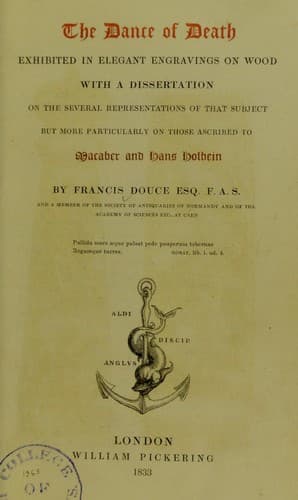
The Dance of Death: Exhibited in Elegant Engravings on Wood with a Dissertation on the Several Representations of that Subject but More Particularly on Those Ascribed to Macaber and Hans Holbein — John Shaqi
The Dance of Death: Exhibited in Elegant Engravings on Wood with a Dissertation on the Several Representations of that Subject but More Particularly on Those Ascribed to Macaber and Hans HolbeinDouce, Francis
History
The Dance of Death: Exhibited in Elegant Engravings on Wood with a Dissertation on the Several Representations of that Subject but More Particularly on Those Ascribed to Macaber and Hans Holbein
Douce, Francis
Bible. Old Testament -- Illustrations; Dance of death
Whether there ever was a Macaber Dance at Berne of equal antiquity with
that of Basle has not been ascertained: but Sandrart, in his article for
Nicolas Manuel Deutch, a celebrated painter at Berne, in the beginning of
the 16th century, has recorded a Dance of Death painted by him in oil, and
regrets that a work materially contributing to the celebrity of that city
had been so extremely neglected that he had only been able to lay before
the readers the following German rhymes which had been inscribed on it:
Manuel aller welt figur,
Hastu gemahlt uf diese mur
Nu must sterben da, hilft kun fund:
Bist nit sicher minut noch stund.
Which he thus translates:
Cunctorum in muris pictis ex arte figuris.
Tu quoque decedes; etsi hoc vix tempore credes.
Then Manuel's answer:
Kilf eineger Heiland! dru ich dich bitt:
Dann hic ist gar kein Bleibens nit
So mir der Tod mein red wird stellen
So bhut euch Gott, mein liebe Gsellen.
That is, in Latin:
En tibi me credo, Deus, hoc dum sorte recedo
Mors rapiat me, te, reliquos sociosque, valete!
To which account M. Fuseli adds, that this painting, equally remarkable
for invention and character, was retouched in 1553; and in 1560, to render
the street in which it was placed more spacious, entirely demolished.
There were, however, two copies of it preserved at Berne, both in water
colours, one by Albrech Kauw, the other a copy from that by Wilhelm
Stettler, a painter of Berne, and pupil of Conrad Meyer of Zurich. The
painting is here said to have been in _fresco_ on the wall of the
Dominican cemetery.[70]
The verses that accompanied this painting have been mentioned as
containing sarcastical freedoms against the clergy; and as Manuel had
himself undergone some persecutions on the score of religion at the time
of the Reformation, this is by no means improbable. There is even a
tradition that he introduced portraits of some of his friends, who
assisted in bringing about that event.
In 1832, lithographic copies of the Berne painting, after the drawings of
Stettler, were published at Berne, with a portrait of Manuel; and a set of
very beautiful drawings in colours, made by some artist at Berne, either
after those by Stettler or Kauw, in the public library, are in the
possession of the writer of this essay. They, as well as the lithographic
prints, exhibit Manuel's likeness in the subject of the painter.
Public-domain text, read in full here on John Shaqi.
Reviews
Reviews
No reviews yet
Be the first to share your thoughts on this work.
Join the Discussion
Join the discussion
Sign in to leave a comment or review.
Sign InorCreate an account