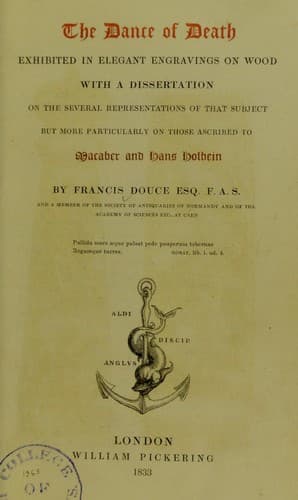
The Dance of Death: Exhibited in Elegant Engravings on Wood with a Dissertation on the Several Representations of that Subject but More Particularly on Those Ascribed to Macaber and Hans HolbeinDouce, Francis
History
The Dance of Death: Exhibited in Elegant Engravings on Wood with a Dissertation on the Several Representations of that Subject but More Particularly on Those Ascribed to Macaber and Hans Holbein
Douce, Francis
Bible. Old Testament -- Illustrations; Dance of death
One of the bridges at Lucerne was covered with a Macaber Dance, executed
by a painter named Meglinger, but at what time we are not informed. It is
said to have been very well painted, but injured greatly by injudicious
retouchings; yet there seems to be a difference of opinion as to the merit
of the paintings, which are or were thirty-six in number, and supposed to
have been copied from the Basle dance. Lucerne has also another of the
same kind in the burial ground of the parish church of Im-hof. One of the
subjects placed over the tomb of some canon, the founder of a musical
society, is Death playing on the violin, and summoning the canon to
follow him, who, not in the least terrified, marks the place in the book
he was reading, and appears quite disposed to obey. This Dance is probably
more modern than the other.[71] The subject of Death performing on the
above instrument to some person or other is by no means uncommon among the
old painters.
M. Maurice Rivoire, in his very excellent description of the cathedral of
Amiens, mentions the cloister of the Machabees, originally called, says
he, the cloister of Macabré, and, as he supposes, from the name of the
author of the verses. He gives some lines that were on one of the walls,
in which the Almighty commands Death to bring all mortals before him.[72]
This cloister was destroyed about the year 1817, but not before the
present writer had seen some vestiges of the painting that remained on one
of the sides of the building.
M. Peignot has a very probable conjecture that the church-yard of Saint
Maclou, at Rouen, had a Macaber Dance, from a border or frieze that
contains several emblematical subjects of mortality. The place had more
than once been destroyed.[73] On the pillars of the church at Fescamp, in
Normandy, the Dance of Death was sculptured in stone, and it is in
evidence that the castle of Blois had formerly this subject represented in
some part of it.
In the course of some recent alterations in the new church of the
Protestants at Strasburg, formerly a Dominican convent, the workmen
accidentally uncovered a Dance of Death that had been whitewashed, either
for the purpose of obliteration or concealment. This painting seems to
differ from the usual Macaber Dance, not always confined like that to two
figures only, but having occasionally several grouped together. M.
Peignot has given some more curious particulars relating to it, extracted
from a literary journal by M. Schweighæuser, of Strasburg.[74] It is to be
hoped that engravings of it will be given.
Chorier has mentioned the mills of Macabrey, and also a piece of land with
the same appellation, which he says was given to the chapter of St.
Maurice at Vienne in Dauphiné, by one Marc Apvril, a citizen of that
place. He adds, that he is well aware of the Dance of Macabre. Is it not,
therefore, probable, that the latter might have existed at Vienne, and
have led to the corruption of the above citizen's name by the common
people.[75]
Public-domain text, read in full here on John Shaqi.
Reviews
Reviews
No reviews yet
Be the first to share your thoughts on this work.
Join the Discussion
Join the discussion
Sign in to leave a comment or review.
Sign InorCreate an account