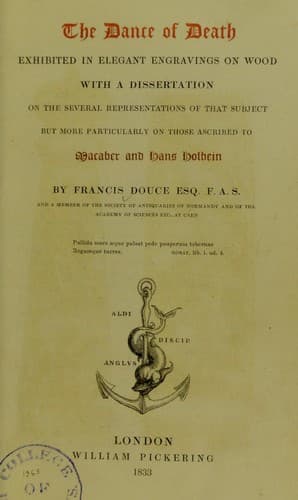
The Dance of Death: Exhibited in Elegant Engravings on Wood with a Dissertation on the Several Representations of that Subject but More Particularly on Those Ascribed to Macaber and Hans Holbein — John Shaqi
The Dance of Death: Exhibited in Elegant Engravings on Wood with a Dissertation on the Several Representations of that Subject but More Particularly on Those Ascribed to Macaber and Hans HolbeinDouce, Francis
History
The Dance of Death: Exhibited in Elegant Engravings on Wood with a Dissertation on the Several Representations of that Subject but More Particularly on Those Ascribed to Macaber and Hans Holbein
Douce, Francis
Bible. Old Testament -- Illustrations; Dance of death
Alasse Dethe alasse a blesful thyng thou were
Yf thou woldyst spare us yn ouwre lustynesse.
And cum to wretches that bethe of hevy chere
Whene thay ye clepe to slake their dystresse
But owte alasse thyne own sely selfwyldnesse
Crewelly werneth me that seygh wayle and wepe
To close there then that after ye doth clepe.
Death answers:
Grosless galante in all thy luste and pryde
Remembyr that thou schalle onys dye
Deth schall fro thy body thy sowle devyde
Thou mayst him not escape certaynly
To the dede bodyes cast down thyne ye
Beholde thayme well consydere and see
For such as thay ar such shalt thou be.
This painting was made about the year 1460, and from the remaining
specimen its destruction is extremely to be regretted, as, judging from
that of the young gallant, the dresses of the time would be correctly
exhibited.
In the chapel at Wortley Hall, in Gloucestershire, there was inscribed,
and most likely painted, "an history and Daunce of Deathe of all estatts
and degrees." This inscribed history was the same as Lydgate's, with some
additional characters.[82] From a manuscript note by John Stowe, in his
copy of Leland's Itinerary, it appears that there was a Dance of Death in
the church of Stratford upon Avon: and the conjecture that Shakespeare, in
a passage in Measure for Measure, might have remembered it, will not,
perhaps, be deemed very extravagant. He there alludes to Death and the
fool, a subject always introduced into the paintings in question.[83]
On the upper part of the great screen which closes the entrance to the
choir of the church at Hexham, in Northumberland, are the painted remains
of a Dance of Death.[84] These consist of the figures of a pope, a
cardinal, and a king, which were copied by the ingenious John Carter, of
well-deserved antiquarian memory.
Vestiges of a Macaber Dance were not long since to be traced on the walls
of the hall of the Archiepiscopal palace at Croydon, but so much obscured
by time and neglect that no particular compartment could be ascertained.
The tapestries that decorated the walls of palaces, and other dwelling
places, were sometimes applied in extension of this moral subject. In the
tower of London, the original and most ancient seat of our monarchs, there
was some tapestry with the Macaber Dance.[85]
The following lines in that admirable satire, the Vision of Pierce
Plowman, written about the year 1350, have evidently an allusion to the
Dance, unless they might be thought to apply rather to the celebrated
triumph of Death by Petrarch, of which some very early paintings, and many
engravings, still exist; or they may even refer to some of the ancient
representations of the infernal regions that follow Death on the Pale
horse of the Revelations, and in which is seen a grotesque intermixture of
all classes of people.[86]
Public-domain text, read in full here on John Shaqi.
Reviews
Reviews
No reviews yet
Be the first to share your thoughts on this work.
Join the Discussion
Join the discussion
Sign in to leave a comment or review.
Sign InorCreate an account