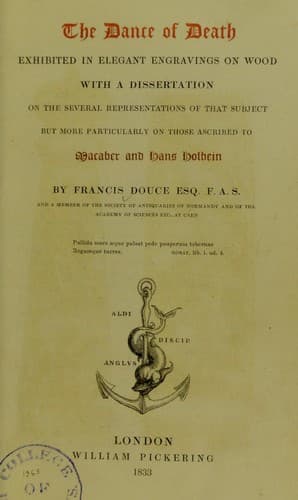
The Dance of Death: Exhibited in Elegant Engravings on Wood with a Dissertation on the Several Representations of that Subject but More Particularly on Those Ascribed to Macaber and Hans HolbeinDouce, Francis
History
The Dance of Death: Exhibited in Elegant Engravings on Wood with a Dissertation on the Several Representations of that Subject but More Particularly on Those Ascribed to Macaber and Hans Holbein
Douce, Francis
Bible. Old Testament -- Illustrations; Dance of death
It can hardly be supposed that this subject was not known in Spain, though
nothing relating to it seems to have been recorded, if we except the poem
that has been mentioned in p. 25, but no Spanish painting has been
specified that can be called a regular Macaber Dance. There are grounds,
however, for believing that there was such a painting in the cathedral of
Burgos, as a gentleman known to the author saw there the remains of a
skeleton figure on a whitewashed wall.
CHAPTER IV.
_Macaber Dance in England.--St. Paul's.--Salisbury.--Wortley
Hall.--Hexham.--Croydon.--Tower of London.--Lines in Pierce Plowman's
Vision supposed to refer to it._
We are next to examine this subject in relation to its existence in our
own country. On the authority of the work ascribed to Walter de Mapes,
already noticed in p. 24, it is not unreasonable to infer that paintings
of the Macaber Dance were coeval with that writer, though no specimens of
it that now remain will warrant the conclusion. We know that it existed at
Old Saint Paul's. Stowe informs us that there was a great cloister on the
north side of the church, environing a plot of ground, of old time called
Pardon church-yard. He then states, that "about this _cloyster_ was
artificially and richly painted the Dance of Machabray, or Dance of Death,
commonly called the Dance of Paul's: the like whereof was painted about
St. Innocent's cloyster at Paris: the meters or poesie of this dance were
translated out of French into English, by John Lidgate, Monke of Bury, the
picture of Death leading all estates; at the dispence of Jenken Carpenter
in the reigne of Henry the Sixt."[78] Lydgate's verses were first printed
at the end of Tottell's edition of the translation of his Fall of Princes,
from Boccaccio, 1554, folio, and afterwards, in Sir W. Dugdale's History
of St. Paul's cathedral.[79] In another place Stowe records that "on the
10th April, 1549, the cloister of St. Paul's church, called Pardon
church-yard, with the Dance of Death, commonly called the Dance of Paul's,
about the same cloister, costly and cunningly wrought, and the chappel in
the midst of the same church-yard, were all begun to be pulled down."[80]
This spoliation was made by the Protector Somerset, in order to obtain
materials for building his palace in the Strand.[81]
The single figure that remained in the Hungerford chapel at Salisbury
cathedral, previously to its demolition, was formerly known by the title
of "Death and the Young Man," and was, undoubtedly, a portion of the
Macaber Dance, as there was close to it another compartment belonging to
the same subject. In 1748, a print of these figures was published,
accompanied with the following inscription, which differs from that in
Lydgate. The young man says:
Public-domain text, read in full here on John Shaqi.
Reviews
Reviews
No reviews yet
Be the first to share your thoughts on this work.
Join the Discussion
Join the discussion
Sign in to leave a comment or review.
Sign InorCreate an account