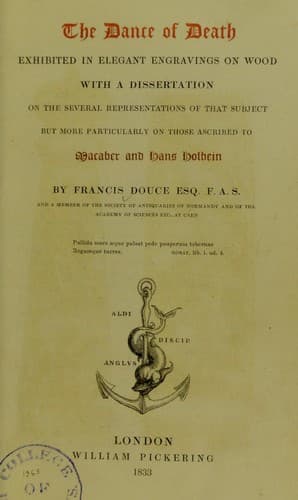
The Dance of Death: Exhibited in Elegant Engravings on Wood with a Dissertation on the Several Representations of that Subject but More Particularly on Those Ascribed to Macaber and Hans HolbeinDouce, Francis
History
The Dance of Death: Exhibited in Elegant Engravings on Wood with a Dissertation on the Several Representations of that Subject but More Particularly on Those Ascribed to Macaber and Hans Holbein
Douce, Francis
Bible. Old Testament -- Illustrations; Dance of death
But it was not only in the above volumes that the very popular subject of
the Macaber Dance was particularly exhibited. It found its way into many
of the beautiful service books, usually denominated Horæ, or hours of the
Virgin. These principally belong to France, and their margins are
frequently decorated with the above Dance, with occasional variety of
design. In most of them Death is accompanied with a single figure only,
characters from both sexes being introduced. It would be impossible to
furnish a complete list of them; but it is presumed that the mention of
several, and of the printers who introduced them, will not be
unacceptable.
No. I. "Las Horas de nuestra Senora con muchos otros oficios y oraçiones."
Printed in Paris by Nicolas Higman for Simon Vostre, 1495, 8vo. It has two
Dances of Death, the first of which is the usual Macaber Dance, with the
following figures: "Le Pape, l'Empereur, le Cardinal, l'Archevesque, le
Chevalier, l'Evesque, l'Escuyer, l'Abè, le Prevost, le Roy, le Patriarche,
le Connestable, l'Astrologien, le Bourgoys, le Chanoine, le Moyne,
l'Usurier, le Medesin, l'Amoureux, l'Advocat, le Menestrier, le Marchant,
le Chartreux, le Sergent, le Cure, le Laboureur, le Cordelier." Then the
women: "La Royne, la Duchesse, la Regente, la Chevaliere, l'Abbesse, la
Femme descine, la Prieure, la Damoissele, la Bourgoise, la Cordeliere, la
Femme daceul, la Nourice, la Theologienne, la nouvelle mariee, la Femme
grosse, la Veufve, la Marchande, la Ballive, la Chamberiere, la
Recommanderese, la vielle Damoise, l'Espousée, la Mignote, la Fille
pucelle, la Garde d'accouchée, la jeune fille, la Religieuse, la Vielle,
la Revenderesse, l'Amoureuse, la Sorciere, la Bigote, la Sote, la Bergere,
la Femme aux Potences, la Femme de Village; to which are added, l'Enfant,
le Clerc, l'Ermite."
The second Dance of Death is very different from the preceding, and
consists of groupes of figures. The subjects, which have never yet been
described, are the following:
1. Death sitting on a coffin in a church-yard. "Discite vos choream cuncti
qui cernitis istam."
2. Death with Adam and Eve in Paradise. He draws Adam towards him. "Quid
tum prosit honor glorie divitie."
3. Death helping Cain to slay Abel. "Esto meorum qui pulvis eris et
vermibus esca."
4. Death holding by the garment a cardinal, followed by several persons.
"In gelida putrens quando jacebis humo."
5. Death mounted on a bull strikes three persons with his dart. "Vado mori
dives auro vel copia rerum."
6. Death seizing a man sitting at a table with a purse in his hand, and
accompanied by two other persons. "Nullum respectum dat michi, vado mori."
7. An armed knight killing an unarmed man, Death assisting. "Fortium
virorum est magis mortem contemnere vitam odisse."
8. Death with a rod in his hand, standing upon a groupe of dead persons.
"Stultum est timere quod vitari non potest."
Public-domain text, read in full here on John Shaqi.
Reviews
Reviews
No reviews yet
Be the first to share your thoughts on this work.
Join the Discussion
Join the discussion
Sign in to leave a comment or review.
Sign InorCreate an account