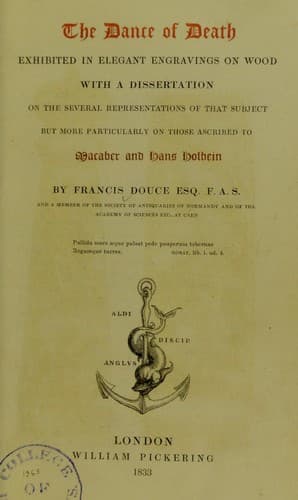
The Dance of Death: Exhibited in Elegant Engravings on Wood with a Dissertation on the Several Representations of that Subject but More Particularly on Those Ascribed to Macaber and Hans Holbein — John Shaqi
The Dance of Death: Exhibited in Elegant Engravings on Wood with a Dissertation on the Several Representations of that Subject but More Particularly on Those Ascribed to Macaber and Hans HolbeinDouce, Francis
History
The Dance of Death: Exhibited in Elegant Engravings on Wood with a Dissertation on the Several Representations of that Subject but More Particularly on Those Ascribed to Macaber and Hans Holbein
Douce, Francis
Bible. Old Testament -- Illustrations; Dance of death
9. Death with a scythe, having mowed down several persons lying on the
ground. "Est commune mori mors nulli parcit honori."
10. A soldier introducing a woman to another man, who holds a scythe in
his hand. Death stands behind. "Mors fera mors nequam mors nulli parcit et
equam."
11. Death strikes with his dart a prostrate female, who is attended by two
others. "Hec tua vita brevis: que te delectat ubique."
12. A man falling from a tower into the water. Death strikes him at the
same time with his dart. "Est velut aura levis te mors expectat ubique."
13. A man strangling another, Death assisting. "Vita quid est hominis nisi
res vallata ruinis."
14. A man at the gallows, Death standing by. "Est caro nostra cinis modo
principium modo finis."
15. A man about to be beheaded, Death assisting. "Quid sublime genus quid
opes quid gloria prestant."
16. A king attended by several persons is struck by Death with his dart.
"Quid mihi nunc aderant hec mihi nunc abeunt."
17. Two soldiers armed with battle-axes. Death pierces one of them with
his dart. "Ortus cuncta suos: repetunt matremque requirunt."
18. Death strikes with his dart a woman lying in bed. "Et redit in nihilum
quod fuit ante nihil."
19. Death aims his dart at a sleeping child in a cradle, two other figures
attending. "A, a, a, vado mori, nil valet ipsa juventus."
20. A man on the ground in a fit, Death seizes him. Others attending.
"Mors scita sed dubia nec fugienda venit."
21. Death leads a man, followed by others. "Non sum securus hodie vel cras
moriturus."
22. Death interrupts a man and woman at their meal. "Intus sive foris est
plurima causa timoris."
23. Death demolishes a group of minstrels, from one of whom he has taken a
lute. "Viximus gaudentes, nunc morimur tristes et flentes."
24. Death leads a hermit, followed by other persons. "Forte dies hec est
ultima, vado mori."
This Dance is also found in the Horæ printed by Godar, Vostre, and Gilles
Hardouyn, but with occasional variations, as to size and other matters, in
the different blocks which they respectively used. The same designs have
also been adopted, and in a very singular style of engraving, in a work
printed by Antony Verard, that will be noticed elsewhere.
Some of the cuts, for they are not all by the same artist, in this very
rare and beautiful volume, and not found in others printed by or for Simon
Vostre, may be very justly compared, in point of the delicacy of design
and engraving, though on wood, with the celebrated pax of Maso Finiguerra
at Florence, accurately copied in Mr. Ottley's history of engraving. They
are accompanied with this unappropriated mark [monogram].
Public-domain text, read in full here on John Shaqi.
Reviews
Reviews
No reviews yet
Be the first to share your thoughts on this work.
Join the Discussion
Join the discussion
Sign in to leave a comment or review.
Sign InorCreate an account