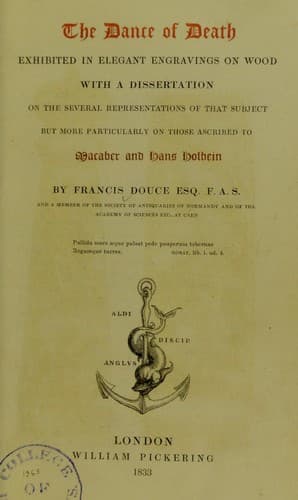
The Dance of Death: Exhibited in Elegant Engravings on Wood with a Dissertation on the Several Representations of that Subject but More Particularly on Those Ascribed to Macaber and Hans Holbein — John Shaqi
The Dance of Death: Exhibited in Elegant Engravings on Wood with a Dissertation on the Several Representations of that Subject but More Particularly on Those Ascribed to Macaber and Hans HolbeinDouce, Francis
History
The Dance of Death: Exhibited in Elegant Engravings on Wood with a Dissertation on the Several Representations of that Subject but More Particularly on Those Ascribed to Macaber and Hans Holbein
Douce, Francis
Bible. Old Testament -- Illustrations; Dance of death
The manner in which the poets and artists of antiquity have symbolized or
personified Death, has excited considerable discussion; and the various
opinions of Lessing, Herder, Klotz, and other controversialists have only
tended to demonstrate that the ancients adopted many different modes to
accomplish this purpose. Some writers have maintained that they
exclusively represented Death as a mere skeleton; whilst others have
contended that this figure, so frequently to be found upon gems and
sepulchral monuments, was never intended to personify the extinction of
human life, but only as a simple and abstract representation. They insist
that the ancients adopted a more elegant and allegorical method for this
purpose; that they represented human mortality by various symbols of
destruction, as birds devouring lizards and serpents, or pecking fruits
and flowers; by goats browsing on vines; cocks fighting, or even by a
Medusa's or Gorgon's head. The Romans seem to have adopted Homer's[1]
definition of Death as the eldest brother of Sleep; and, accordingly, on
several of their monumental and other sculptures we find two winged genii
as the representatives of the above personages, and sometimes a genius
bearing a sepulchral vase on his shoulder, and with a torch reversed in
one of his hands. It is very well known that the ancients often symbolized
the human soul by the figure of a butterfly, an idea that is extremely
obvious and appropriate, as well as elegant. In a very interesting
sepulchral monument, engraved in p. 7 of Spon's Miscellanea Eruditæ
Antiquitatis, a prostrate corpse is seen, and over it a butterfly that has
just escaped from the _mouth_ of the deceased, or as Homer expresses it,
"from the teeth's inclosure."[2] The above excellent antiquary has added
the following very curious sepulchral inscription that was found in Spain,
HÆREDIBVS MEIS MANDO ETIAM CINERE VTMEO VOLITET EBRIVS PAPILIO OSSA IPSA
TEGANT MEA, &c. Rejecting this heathen symbol altogether, the painters and
engravers of the middle ages have substituted a small human figure
escaping from the mouths of dying persons, as it were, breathing out their
souls.
We have, however, the authority of Herodotus, that in the banquets of the
Egyptians a person was introduced who carried round the table at which
the guests were seated the figure of a dead body, placed on a coffin,
exclaiming at the same time, "Behold this image of what yourselves will
be; eat and drink therefore, and be happy."[3] Montfaucon has referred to
an ancient manuscript to prove that this sentiment was conveyed in a
Lacedæmonian proverb,[4] and it occurs also in the beautiful poem of
Coppa, ascribed to Virgil, in which he is supposed to invite Mæcenas to a
rural banquet. It concludes with these lines:--
Pone merum et talos; pereat qui crastina curat,
Mors aurem vellens, vivite ait, venio.
Public-domain text, read in full here on John Shaqi.
Reviews
Reviews
No reviews yet
Be the first to share your thoughts on this work.
Join the Discussion
Join the discussion
Sign in to leave a comment or review.
Sign InorCreate an account