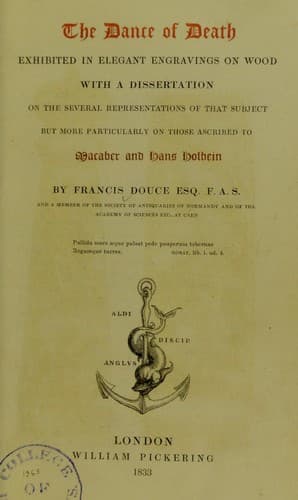
The Dance of Death: Exhibited in Elegant Engravings on Wood with a Dissertation on the Several Representations of that Subject but More Particularly on Those Ascribed to Macaber and Hans HolbeinDouce, Francis
History
The Dance of Death: Exhibited in Elegant Engravings on Wood with a Dissertation on the Several Representations of that Subject but More Particularly on Those Ascribed to Macaber and Hans Holbein
Douce, Francis
Bible. Old Testament -- Illustrations; Dance of death
The phrase of pulling the ear is admonitory, that organ being regarded by
the ancients as the seat of memory. It was customary also, and for the
same reason, to take an oath by laying hold of the ear. It is impossible
on this occasion to forget the passage in Isaiah xxii. 13, afterwards used
by Saint Paul, on the beautiful parable in Luke xii. Plutarch also, in his
banquet of the wise men, has remarked that the Egyptians exhibited a
skeleton at their feasts to remind the parties of the brevity of human
life; the same custom, as adopted by the Romans, is exemplified in
Petronius's description of the feast of Trimalchio, where a jointed
puppet, as a skeleton, is brought in by a boy, and this practice is also
noticed by Silius Italicus:
... Ægyptia tellus
Claudit odorato post funus stantia Saxo
Corpora, et a mensis exsanguem haud separat umbram.[5]
Some have imagined that these skeletons were intended to represent the
larvæ and lemures, the good and evil shadows of the dead, that
occasionally made their appearance on earth. The larvæ, or lares, were of
a beneficent nature, friendly to man; in other words, the good demon of
Socrates. The lemures, spirits of mischief and wickedness. The larva in
Petronius was designed to admonish only, not to terrify; and this is
proved from Seneca: "Nemo tam puer est ut Cerberum timeat et tenebras, et
larvarum habitum nudis ossibus cohærentium."[6] There is, however, some
confusion even among the ancients themselves, as to the respective
qualities of the larvæ and lemures. Apuleius, in his noble and interesting
defence against those who accused him of practising magic, tells them,
"Tertium mendacium vestrum fuit, macilentam vel omnino evisceratam formam
diri cadaveris fabricatam prorsus horribilem et larvalem;" and afterwards,
when producing the image of his peculiar Deity, which he usually carried
about him, he exclaims, "En vobis quem scelestus ille sceletum nominabat!
Hiccine est sceletus? Hæccine est larva? Hoccine est quod appellitabatis
Dæmonium."[7] It is among Christian writers and artists that the
personification of Death as a skeleton is intended to convey terrific
ideas, conformably to the system that Death is the punishment for original
sin.
Public-domain text, read in full here on John Shaqi.
Reviews
Reviews
No reviews yet
Be the first to share your thoughts on this work.
Join the Discussion
Join the discussion
Sign in to leave a comment or review.
Sign InorCreate an account