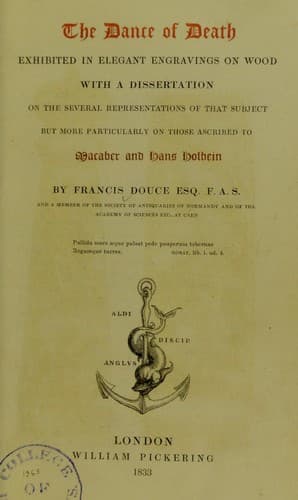
The Dance of Death: Exhibited in Elegant Engravings on Wood with a Dissertation on the Several Representations of that Subject but More Particularly on Those Ascribed to Macaber and Hans HolbeinDouce, Francis
History
The Dance of Death: Exhibited in Elegant Engravings on Wood with a Dissertation on the Several Representations of that Subject but More Particularly on Those Ascribed to Macaber and Hans Holbein
Douce, Francis
Bible. Old Testament -- Illustrations; Dance of death
_Holbein's Bible cuts.--Examination of the claim of Hans Lutzenberger
as to the design or execution of the Lyons engravings of the Dance of
Death.--Other works by him._
At this time the celebrated designs for the illustration of the Old
Testament, usually denominated Holbein's Bible, made their appearance,
with the following title, "Historiarum veteris instrumenti icones ad vivum
expressæ. Una cum brevi, sed quoad fieri potuit, dilucida earundem
expositione. Lugduni, sub scuto Coloniensi MDXXXVIII." 4to. They were
several times republished with varied titles, and two additional cuts.
Prefixed are some highly complimentary Latin verses by Holbein's friend
Nicholas Bourbon, better known by his Latinized name of Borbonius, who
again introduces Parrhasius and Zeuxis in Elysium, and in conversation
with Apelles, who laments that they had all been excelled by Holbein.
These lines by Borbonius do not appear, among others addressed by him to
Holbein, in the first edition of his "Nugæ" in 1533, or indeed in any of
the subsequent editions; but it is certain that Borbonius was at Lyons in
1538, and might then have been called on by the publishers of the designs,
with whom he was intimately connected, for the commendatory verses.
The booksellers Frellon of Lyons, by some means with which we are not now
acquainted, or indeed ever likely to be, became possessed of the copyright
to these designs for the Old Testament. It is very clear that they had
previously been in possession of those for the Dance of Death, and,
finding the first four of them equally adapted to a Bible, they
accordingly, and for the purpose of saving expense, made use of them in
this Bible, though with different descriptions, having, in all
probability, employed the same engraver on wood as in the Dance of Death,
a task to which he had already demonstrated himself to be fully competent.
Now, if the Frellons had regarded Holbein as the designer of the
"Simulachres et historiees faces de la Mort," would they not rather have
introduced into that work the complimentary lines of Borbonius on _some_
painting by Holbein of a Dance of Death, and which will be hereafter more
particularly adverted to, instead of inserting the very interesting and
decisive dedication that has so emphatically referred to the then deceased
painter of the above admirable composition?
Public-domain text, read in full here on John Shaqi.
Reviews
Reviews
No reviews yet
Be the first to share your thoughts on this work.
Elsewhere in the archive
Join the Discussion
Join the discussion
Sign in to leave a comment or review.
Sign InorCreate an account