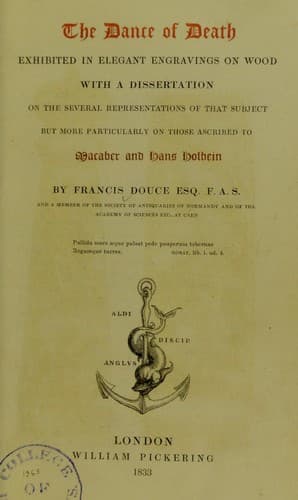
The Dance of Death: Exhibited in Elegant Engravings on Wood with a Dissertation on the Several Representations of that Subject but More Particularly on Those Ascribed to Macaber and Hans HolbeinDouce, Francis
History
The Dance of Death: Exhibited in Elegant Engravings on Wood with a Dissertation on the Several Representations of that Subject but More Particularly on Those Ascribed to Macaber and Hans Holbein
Douce, Francis
Bible. Old Testament -- Illustrations; Dance of death
X. "Imagines Mortis: item epigrammata è Gall. à G. Æmilio in Latinum
versa. Lugdun. Frellonius, 1574." 12mo.[114]
XI. In 1654 a Dutch work appeared with the following title, "De Doodt
vermaskert met swerelts ydelheyt afghedaen door G. V. Wolsschaten,
verciert met de constighe Belden vanden maerden Schilder Hans Holbein.
_i. e._ Death masked, with the world's vanity, by G. V. Wolsschaten,
ornamented with the ingenious images of the famous painter Hans Holbein.
T'Antwerpen, by Petrus Bellerus." This is on an engraved frontispiece of
tablet, over which are spread a man's head and the skin of two arms
supported by two Deaths blowing trumpets. Below, a spade, a pilgrim's
staff, a scepter, and a crosier, with a label, on which is "sceptra
ligonibus æquat." Then follows another title-page, with the same words,
and the addition of Geeraerdt Van Wolsschaten's designation, "Prevost van
sijne conincklijcke Majesteyts Munten des Heertoogdoms van Brabant, &c.
MDCLIV." 12mo. The author of the text, which is mixed up with poetry and
historical matter, was prefect of the mint in the Duchy of Brabant.[115]
This edition contains eighteen cuts, among which the following subjects
are from the original blocks. 1. Three boys. 2. The married couple. 3. The
pedlar. 4. The shipwreck. 5. The beggar. 6. The corrupt judge. 7. The
astrologer. 8. The old man. 9. The physician. 10. The priest with the
eucharist. 11. The monk. 12. The abbess. 13. The abbot. 14. The duke. Four
others, viz. the child, the emperor, the countess, and the pope, are
copies, and very badly engraved. The blocks of the originals appear to
have fallen into the hands of an artist, who probably resided at Antwerp,
and several of them have his mark, [monogram: SA], concerning which more
will be said under one of the ensuing articles. As many engravings on wood
by this person appeared in the middle of the sixteenth century, it is
probable that he had already used these original blocks in some edition of
the Dance of Death that does not seem to have been recorded. There are
evident marks of retouching in these cuts, but when they first appeared
cannot now be ascertained. The mark might have been placed on them, either
to denote ownership, according to the usual practice at that time, or to
indicate that they had been repaired by that particular artist.
All these editions, except that of 1574, have been seen and carefully
examined on the present occasion: the supposed one of 1530 has not been
included in this list, and remains to be seen and accurately described, if
existing, by competent witnesses.
Public-domain text, read in full here on John Shaqi.
Reviews
Reviews
No reviews yet
Be the first to share your thoughts on this work.
Elsewhere in the archive
Join the Discussion
Join the discussion
Sign in to leave a comment or review.
Sign InorCreate an account