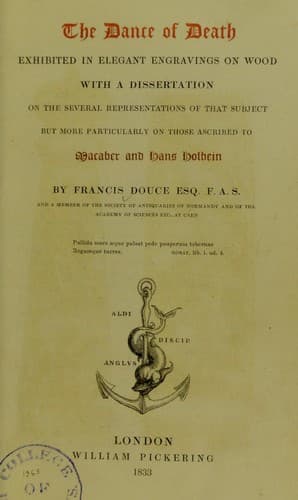
The Dance of Death: Exhibited in Elegant Engravings on Wood with a Dissertation on the Several Representations of that Subject but More Particularly on Those Ascribed to Macaber and Hans HolbeinDouce, Francis
History
The Dance of Death: Exhibited in Elegant Engravings on Wood with a Dissertation on the Several Representations of that Subject but More Particularly on Those Ascribed to Macaber and Hans Holbein
Douce, Francis
Bible. Old Testament -- Illustrations; Dance of death
The Abbess. 14. The Friar. 15. The
Nun. 16. The Preacher. 17. The Physician. 18. The Soldier, or Warrior. 19.
The Advocate. 20. The Married Couple. 21. The Duchess. 22. The Merchant.
23. The Pedlar. 24. The Miser. 25. The Waggoner with wine casks. 26. The
Gamesters. 27. The Old Man. 28. The Old Woman. 29. The Infant. Of these,
Nos. 1, 5, 6, 8, 9, 13, 14, 23, 27, and 28, correspond with the Lyons
wood-cuts, except that in No. 1 a stag is omitted, and there are some
variations; in No. 6, the windows of the palace are altered; in No. 13, a
window is added to the house next to the nunnery; and in No. 9, a figure
is introduced, and the ducal palace much altered; in No. 23, a sword is
omitted. They are all reverses, except No. 5. The rest of the subjects are
reversed, with one exception, from the copies by [monogram: SA] in the
spurious edition first printed at Cologne in 1555, with occasional very
slight variations. Hollar's copies from the original cuts are in a small
degree less both in width and depth. In the subject of Death and the
Soldier he has not shown his judgment in making use of the spurious
edition rather than the far more elegant and interesting original,[122]
and it is remarkable that this is the only print belonging to the spurious
ones that is not reversed.
It is very probable that Hollar executed this work at Antwerp, where, at
the time of its date, he might have found Diepenbecke and engaged him to
make designs for the borders which are etched on separate plates, thus
supplying passe-par-touts that might be used at discretion. Many sets
appear without the borders, which seem to have strayed, and perhaps to
have been afterwards lost or destroyed. As Rubens is recorded to have
admired the beauty of the original cuts, so it is to be supposed that
Diepenbecke, his pupil, would entertain the same opinion of them, and that
he might have suggested to Hollar the making etchings of them, undertaking
himself to furnish appropriate borders. But how shall we account for the
introduction of so many of the spurious and inferior designs, if he had
the means of using the originals? Many books were formerly excessively
rare, which, from peculiar circumstances, not necessary to be here
detailed, but well known to bibliographers and collectors, have since
become comparatively common. Hollar might not have had an opportunity of
meeting with a perfect copy of the original cuts, or he might, in some way
or other, have been impeded in the use of them, when executing his work,
and thus have been driven to the necessity of pursuing it by means of the
spurious edition. These, however, are but conjectures, and it remains for
every one to adopt his own opinion.
Public-domain text, read in full here on John Shaqi.
Reviews
Reviews
No reviews yet
Be the first to share your thoughts on this work.
Elsewhere in the archive
Join the Discussion
Join the discussion
Sign in to leave a comment or review.
Sign InorCreate an account