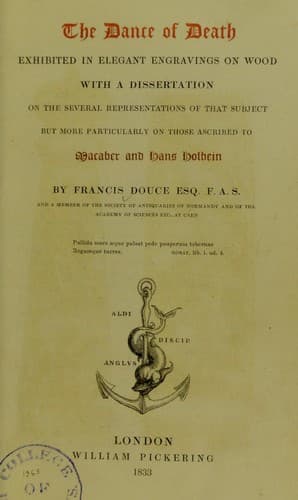
The Dance of Death: Exhibited in Elegant Engravings on Wood with a Dissertation on the Several Representations of that Subject but More Particularly on Those Ascribed to Macaber and Hans Holbein — John Shaqi
The Dance of Death: Exhibited in Elegant Engravings on Wood with a Dissertation on the Several Representations of that Subject but More Particularly on Those Ascribed to Macaber and Hans HolbeinDouce, Francis
History
The Dance of Death: Exhibited in Elegant Engravings on Wood with a Dissertation on the Several Representations of that Subject but More Particularly on Those Ascribed to Macaber and Hans Holbein
Douce, Francis
Bible. Old Testament -- Illustrations; Dance of death
hand of Wolgemut, the master of Albert Durer, has not omitted to exhibit
the representations of the above unhappy persons, equally correct, no
doubt, as the story itself, though the same warranty cannot be offered for
a similar representation, in Gottfried's Chronicle and that copious
repertory of monstrosities, Boistuau and Belleforest's Histoires
Prodigieuses. The Nuremberg Chronicle[11] has yet another relation on this
subject of some persons who continued dancing and singing on a bridge
whilst the eucharist was passing over it. The bridge gave way in the
middle, and from one end of it 200 persons were precipitated into the
river Moselle, the other end remaining so as to permit the priest and his
host to pass uninjured.
In that extremely curious work, the Manuel de Pêché, usually ascribed to
Bishop Grosthead, the pious author, after much declamation against the
vices of the times, has this passage:--
Karoles ne lutes ne deit nul fere,
En seint eglise ki me voil crere;
Kas en cimetere karoler,
Utrage est grant u lutter.[12]
He then relates the story in the Nuremberg Chronicle, for which he quotes
the book of Saint Clement. Grosthead's work was translated about the year
1300 into English verse by Robert Mannyng, commonly called Robert de
Brunne, a Gilbertine canon. His translation often differs from his
original, with much amplification and occasional illustrations by himself.
As the account of the Nuremberg story varies so materially, and as the
scene is laid in England, it has been thought worth inserting.
Public-domain text, read in full here on John Shaqi.
Reviews
Reviews
No reviews yet
Be the first to share your thoughts on this work.
Join the Discussion
Join the discussion
Sign in to leave a comment or review.
Sign InorCreate an account