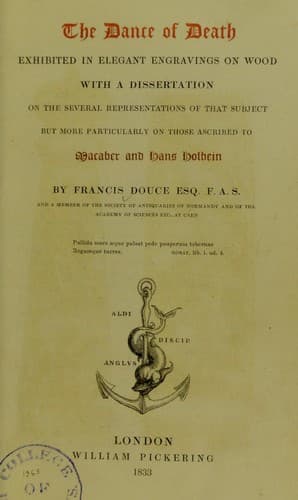
The Dance of Death: Exhibited in Elegant Engravings on Wood with a Dissertation on the Several Representations of that Subject but More Particularly on Those Ascribed to Macaber and Hans Holbein — John Shaqi
The Dance of Death: Exhibited in Elegant Engravings on Wood with a Dissertation on the Several Representations of that Subject but More Particularly on Those Ascribed to Macaber and Hans HolbeinDouce, Francis
History
The Dance of Death: Exhibited in Elegant Engravings on Wood with a Dissertation on the Several Representations of that Subject but More Particularly on Those Ascribed to Macaber and Hans Holbein
Douce, Francis
Bible. Old Testament -- Illustrations; Dance of death
It is very well known to have been the practice in very early times to
profane the temples of the Deity with indecorous dancing, and ludicrous
processions, either within or near them, in imitation, probably, of
similar proceedings in Pagan times. Strabo mentions a custom of this
nature among the Celtiberians,[8] and it obtained also among several of
the northern nations before their conversion to Christianity. A Roman
council, under Pope Eugenius II. in the 9th century, has thus noticed it:
"Ut sacerdotes admoneant viros ac mulieres, qui festis diebus ad ecclesiam
occurrunt, ne _ballando_ et turpia verba decantando choros teneant, ac
ducunt, similitudinem Paganorum peragendo." Canciani mentions an ancient
bequest of money for a dance in honour of the Virgin.[9]
These riotous and irreverent tripudists and caperers appear to have
possessed themselves of the church-yards to exhibit their dancing
fooleries, till this profanation of consecrated ground was punished, as
monkish histories inform us, with divine vengeance. The well-known
Nuremberg Chronicle[10] has recorded, that in the time of the Emperor
Henry the Second, whilst a priest was saying mass on Christmas Eve, in the
church of Saint Magnus, in the diocese of Magdeburg, a company of eighteen
men and ten women amused themselves with dancing and singing in the
church-yard, to the hindrance of the priest in his duty. Notwithstanding
his admonition, they refused to desist, and even derided the words he
addressed to them. The priest being greatly provoked at their conduct,
prayed to God and Saint Magnus that they might remain dancing and singing
for a whole year without intermission, and so it happened; neither dew nor
rain falling upon them. Hunger and fatigue were set at defiance, nor were
their shoes or garments in the least worn away. At the end of the year
they were released from their situation by Herebert, the archbishop of the
diocese in which the event took place, and obtained forgiveness before
the altar of the church; but not before the daughter of a priest and two
others had perished; the rest, after sleeping for the space of three whole
nights, died soon afterwards. Ubert, one of the party, left this story
behind him, which is elsewhere recorded, with some variation and
additional matter. The dance is called St. Vitus's, and the girl is made
the daughter of a churchwarden, who having taken her by the arm, it came
off, but she continued dancing. By the continual motion of the dancers
they buried themselves in the earth to their waists. Many princes and
others went to behold this strange spectacle, till the bishops of Cologne
and Hildesheim, and some other devout priests, by their prayers, obtained
the deliverance of the culprits; four of the party, however, died
immediately, some slept three days and three nights, some three years, and
others had trembling in their limbs during the whole of their lives. The
Nuremberg Chronicle, crowded as it is with wood-cut embellishments by the
Public-domain text, read in full here on John Shaqi.
Reviews
Reviews
No reviews yet
Be the first to share your thoughts on this work.
Join the Discussion
Join the discussion
Sign in to leave a comment or review.
Sign InorCreate an account