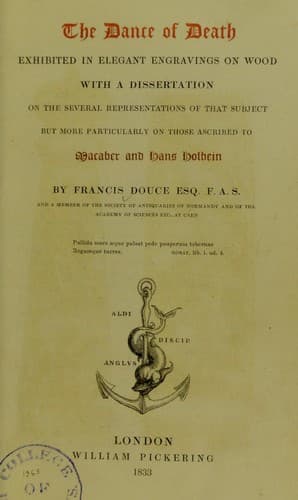
The Dance of Death: Exhibited in Elegant Engravings on Wood with a Dissertation on the Several Representations of that Subject but More Particularly on Those Ascribed to Macaber and Hans HolbeinDouce, Francis
History
The Dance of Death: Exhibited in Elegant Engravings on Wood with a Dissertation on the Several Representations of that Subject but More Particularly on Those Ascribed to Macaber and Hans Holbein
Douce, Francis
Bible. Old Testament -- Illustrations; Dance of death
"Sir,--The costly palace of Whitehall, erected by Cardinal Wolsey, and
the residence of King Henry VIII. contains, among other performances
of art, a _Dance of Death_, painted by Holbein in its galleries,
which, through an unfortunate conflagration, has been reduced to
ashes; and even the little work which he has engraved with his own
hand, and which I have copied as near as possible, is so scarce, that
it is known only to a few lovers of art. And since the court has
thought proper, in consideration of your singular deserts, to cause a
dwelling to be built for you at Whitehall, I imagined it would not be
disagreeable to you to be made acquainted with the former decorations
of that palace. It will not appear strange that the artist should have
chosen the above subject for ornamenting the _royal_ walls, if we
consider that the founder of the Greek monarchy directed that he
should be daily reminded of the admonition, 'Remember, Philip, that
thou art a man.' In like manner did Holbein with his pencil give
tongues to these walls to impress not only the king and his court, but
every one who viewed them with the same reflection."
He then proceeds to describe each of the subjects, and concludes with some
moral observations.
In another copy of these etchings the dedication is to
"The high, noble, and wellborn Lord William Benting, Lord of Rhoon,
Pendreght, &c."
"Sir,--In the course of my constant love and pursuit of works of art,
it has been my good fortune to meet with that scarce little work of
Hans Holbein neatly engraved on wood, and which he himself had painted
as large as life in fresco on the walls of Whitehall. In the copy
which I presume to lay before you, as being born in the same palace, I
have followed the original as nearly as possible, and considering the
partiality which every one has for the place of his birth, a
description of what is remarkable and curious therein and now no
longer existing on account of its destruction by a fatal fire, must
needs prove acceptable, as no other remains whatever have been left of
that once so famous court of King Henry VIII. built by Cardinal
Wolsey, than your own dwelling."
He then repeats the story of Philip of Macedon, and the account of the
subjects of his etchings.
At the end of this dedication there is a fragment of another, the
beginning of which is lost. The following passages only in it are worthy
of notice. "The residence of King William." "I flatter myself with a
familiar acquaintance with Death, since I have already lived long enough
to seem to be buried alive, &c." In other respects, the same, in
substance, as the preceding.
Public-domain text, read in full here on John Shaqi.
Reviews
Reviews
No reviews yet
Be the first to share your thoughts on this work.
Elsewhere in the archive
Join the Discussion
Join the discussion
Sign in to leave a comment or review.
Sign InorCreate an account