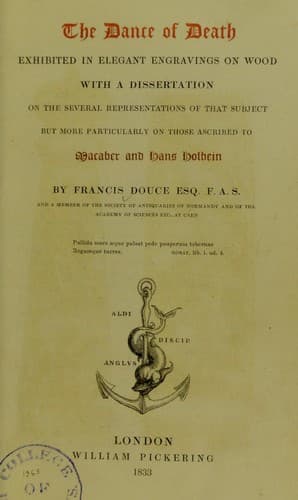
The Dance of Death: Exhibited in Elegant Engravings on Wood with a Dissertation on the Several Representations of that Subject but More Particularly on Those Ascribed to Macaber and Hans HolbeinDouce, Francis
History
The Dance of Death: Exhibited in Elegant Engravings on Wood with a Dissertation on the Several Representations of that Subject but More Particularly on Those Ascribed to Macaber and Hans Holbein
Douce, Francis
Bible. Old Testament -- Illustrations; Dance of death
It is almost needless to advert to M. Nieuhoff Piccard's mistake in
asserting that Holbein made the engravings which he copied; but it would
have been of some importance if, instead of his pious ejaculations, he had
described all the subjects that Holbein painted on the walls of the
galleries at Whitehall. He must have used some edition of the wood-cuts
posterior to that of 1545, which did not contain the subjects of the
German soldier, the fool, and the blind man, all of which he has
introduced. It is possible, however, that he has given us all the subjects
that were then remaining, the rest having become decayed or obliterated
from dampness and neglect, and even those which then existed would soon
afterwards perish when the remains of the old palace were removed. His
copies are by no means faithful, and seem to be rather the production of
an amateur than of a regular artist. For his greater convenience, he
appears to have preferred using the wood engravings instead of the
paintings; and it is greatly to be regretted that we have no better or
further account of them, especially of the time at which they were
executed. The lives of Holbein that we possess are uniformly defective in
chronological arrangement. There seems to be a doubt whether the Earl of
Arundel recommended him to visit England; but certain it is that in the
year 1526 he came to London with a letter of that date addressed by
Erasmus to Sir Thomas More, accompanied with his portrait, with which More
was so well satisfied that he retained him at his house at Chelsea upwards
of two years, until Henry VIII. from admiration of his works, appointed
him his painter, with apartments at Whitehall. In 1529 he visited Basle,
but returned to England in 1530. In 1535 he drew the portrait of his
friend Nicholas Bourbon or Borbonius at London, probably the
before-mentioned crayon drawing at Buckingham House, or some duplicate of
it. In 1538 he painted the portrait of Sir Richard Southwell, a privy
counsellor to Henry VIII. which was afterwards in the gallery of the Grand
Duke of Tuscany.[128] About this time the magistrates of the city of Basle
settled an annuity on him, but conditionally that he should return in two
years to his native place and family, with which terms he certainly did
not comply, preferring to remain in England. In the last-mentioned year he
was sent by the king into Burgundy to paint the portrait of the Duchess of
Milan, and in 1539 to Germany to paint that of Anne of Cleves. In some
household accounts of Henry VIII. there are payments to him in 1538, 1539,
1540, and 1541, on account of his salary, which appears to have been
thirty pounds per annum.[129] From this time little more is recorded of
him till 1553, when he painted Queen Mary's portrait, and shortly
afterwards died of the plague in London in 1554.
Public-domain text, read in full here on John Shaqi.
Reviews
Reviews
No reviews yet
Be the first to share your thoughts on this work.
Elsewhere in the archive
Join the Discussion
Join the discussion
Sign in to leave a comment or review.
Sign InorCreate an account