The Dances of Death: Through the Various Stages of Human Life: Wherein the Capriciousness of that Tyrant is Exhibited
Philosophy
The Dances of Death: Through the Various Stages of Human Life: Wherein the Capriciousness of that Tyrant is Exhibited
Dance of death; Dance of death in art
Produced by Chris Curnow and the Online Distributed
Proofreading Team at http://www.pgdp.net (This file was
produced from images generously made available by The
Internet Archive)
THE DANCES OF DEATH
[Illustration]
[Illustration: _Mors Sceptra ligonebus æquat._]
_LE TRIOMPHE DE LA MORT_
_Gravé d’aprés les Dessins
originaux de_
JEAN HOLBEIN
_par_
DAVID DEUCHAR
1786
_Deuchar fecit_
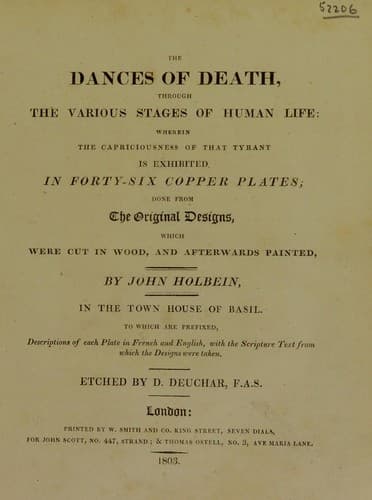
THE
DANCES OF DEATH,
THROUGH
THE VARIOUS STAGES OF HUMAN LIFE:
WHEREIN
THE CAPRICIOUSNESS OF THAT TYRANT
IS EXHIBITED
_IN FORTY-SIX COPPER PLATES_;
DONE FROM
The Original Designs,
WHICH
WERE CUT IN WOOD, AND AFTERWARDS PAINTED,
_BY JOHN HOLBEIN_,
IN THE TOWN HOUSE OF BASIL.
TO WHICH ARE PREFIXED,
_Descriptions of each Plate in French and English, with the
Scripture Text from which the Designs were taken_.
ETCHED BY D. DEUCHAR, F.A.S.
London:
PRINTED BY W. SMITH AND CO. KING STREET, SEVEN DIALS, FOR
JOHN SCOTT, NO. 447, STRAND; & THOMAS OSTELL, NO. 3, AVE MARIA LANE.
1803.
[Illustration]
PREFACE.
JOHN or HANS HOLBEIN was born at Basil in 1498, and died at London of
the plague in 1554, aged 56. This admirable Painter was instructed in
the art by his father JOHN HOLBEIN. In the early part of his life, he
pursued his studies with incessant assiduity; and being possessed of an
elevated genius, his progress was exceedingly rapid; so that he soon
became far superior to his instructor. He painted equally well in oil,
water colours, and in fresco; and although he had never practised the art
of painting in miniature till he resided in England, yet he afterwards
carried it to its highest perfection.
The invention of Holbein was surprisingly fruitful, and often poetical;
his execution was remarkably quick, and his application indefatigable.
His pencil was exceedingly delicate; his coloring had a wonderful
degree of force; he finished his pictures with exquisite neatness; and
his carnations were life itself. He excelled all his cotemporaries in
portrait, and his genuine works are always distinguishable by the true,
round, lively imitation of flesh visible in them, and also by the amazing
delicacy of his finishing.
Public-domain text, read in full here on John Shaqi.
Reviews
Reviews
No reviews yet
Be the first to share your thoughts on this work.
Join the Discussion
Join the discussion
Sign in to leave a comment or review.
Sign InorCreate an account