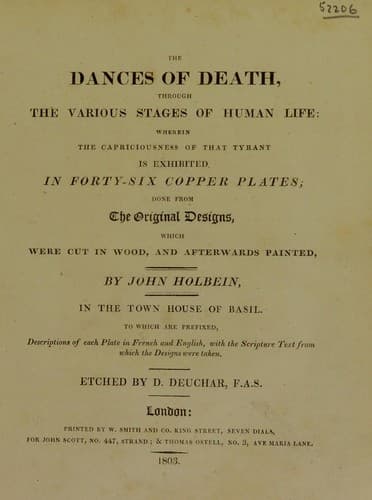
The Dances of Death: Through the Various Stages of Human Life: Wherein the Capriciousness of that Tyrant is Exhibited — John Shaqi
The Dances of Death: Through the Various Stages of Human Life: Wherein the Capriciousness of that Tyrant is Exhibited
Philosophy
The Dances of Death: Through the Various Stages of Human Life: Wherein the Capriciousness of that Tyrant is Exhibited
Dance of death; Dance of death in art
We see Death here venting his capricious fury on a cart of wine that a
poor Waggoner is conducting. Without doubt, the man himself will soon
come, in his turn, to be the sport of his caprice; and the same cause
that has now produced, will ere long effectually finish his despair.
[Illustration: _Cæcus cæcum ducit: & ambo in foveam cadunt. Matth. xv.
14._]
PLANCHE XXXV.—LE VOITURIER.
On voit ici la Mort exercer ses bizarres fureurs sur un char de vin
que conduit un pauvre Voiturier. Sans doute que lui-même va devenir
à son tour le jouet de ses caprices, & que la même cause qui vient
d’occasionner son désespoir ne tardera pas à le terminer.
PLATE XXXVI.—THE HUSBANDMAN.
Were Death capable of considerations, what class of society would
better deserve to be exempted from his ravages, than the labourers;
incontestably the most useful, most laborious, and most productive of
real opulence? But he is now striking the horses harnessed to this
Husbandman’s plough; and this enemy of the human race can strike no
blow more severely felt, than by thus attacking it in the source of its
subsistence.
[Illustration: _In sudore vultus tui vesceris pane tuo. Gen. iii. 19._]
PLANCHE XXXVI.—LE LABOUREUR.
Si la Mort pouvoit user de quelque considération, quelle classe de la
société mériteroit mieux d’en être ménagée que celle du laboureur, sans
contredit la plus utile, la plus laborieuse, & la plus productive des
véritables richesses? Mais elle frappe déjà les chevaux attelés à la
charrue de ce Cultivateur, & cette ennemie du genre humain ne sauroit lui
porter des coups plus sensibles qu’en l’attaquant dans les sources de sa
subsistance.
PLATE XXXVII.—THE MISER.
The character of the Miser is very forcibly expressed in this sketch.
Shut up in a vault, which receives the light only through a wicket,
secured with a double grate of thick iron bars, he is entirely taken up
with his beloved treasure, a considerable part whereof Death is snatching
up before his eyes. This loss excites in him all the symptoms of the most
violent desperation, and it plainly appears that his gold is an hundred
times dearer to his heart than his life.
[Illustration: _Stulte, hac nocte repetunt animam tuam: & quæ parasti,
cujus erunt? Lucæ xii. 20._]
PLANCHE XXXVII.—L’AVARE.
Le caractère de l’Avare est rendu dans ce dessein avec beaucoup
d’énergie. Renfermé dans un caveau qui ne reçoit du jour que par une
lucarne garnie d’une double grille d’épais barreaux de fer, il n’est
occupé que de son cher trésor, dont la Mort lui enlève à ses yeux un
portion très-considérable. Cette perte excite en lui tous les symptômes
du plus violent désespoir, & l’on voit bien que son or lui tient cent
fois plus à cœur que la vie.
PLATE XXXVIII.—THE HIGHWAY ROBBER.
Public-domain text, read in full here on John Shaqi.
Reviews
Reviews
No reviews yet
Be the first to share your thoughts on this work.
Join the Discussion
Join the discussion
Sign in to leave a comment or review.
Sign InorCreate an account