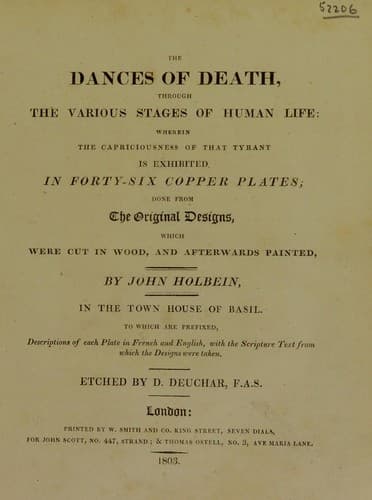
The Dances of Death: Through the Various Stages of Human Life: Wherein the Capriciousness of that Tyrant is Exhibited — John Shaqi
The Dances of Death: Through the Various Stages of Human Life: Wherein the Capriciousness of that Tyrant is Exhibited
Philosophy
The Dances of Death: Through the Various Stages of Human Life: Wherein the Capriciousness of that Tyrant is Exhibited
Dance of death; Dance of death in art
In the most deplorable situation, lame, and exposed almost naked to the
injuries of the weather, he is set down before a rich man’s house, into
which he has the mortification to see several enter, who look at him
without ever thinking of relieving his distress. Death, not less cruel
than capricious, whose aid alone he implores, and in whose power it is to
make him happy, deaf to his prayers, allows him to groan under the load
of evils which overwhelm him, whilst he delights to tear from this life
those who think themselves happy, or are attached to it by the strongest
ties.
[Illustration: _Corruit in curru suo. Chron. xxii._]
PLANCHE XLIV.—LE MENDIANT.
Dans l’état le plus déplorable, estropié, exposé presque nud aux injures
du tems, il est assis devant la maison d’un homme opulent, dans laquelle
il a la douleur de voir entrer plusieurs personnes qui le regardent sans
songer à soulager ses peines. La Mort non moins cruelle que bizarre, dont
lui seul implore le secours, & qui pourroit faire son bonheur, sourde
à ses prières, le laisse gémir sous le poids des maux qui l’accablent,
tandis qu’elle se plaît à arracher de cette vie ceux qui s’y croient
heureux, ou qui y tiennent par les liens les plus puissans.
PLATE XLV.—THE CHILD.
If under the roof of poverty there is any comfort, it is in having
children, by whom we may hope one day to be solaced. This is the case
with this poor widow; but death is of a different opinion, and is come to
carry off her youngest Child, unmoved by her prayers and lamentations.
[Illustration: _Homo natus de muliere, brevi vivens tempore, repletur
multis miseriis: qui quasi flos egreditur & conteritur, & fugit velut
umbra. Job xiv. 1, 2._]
PLANCHE XLV.—L’ENFANT.
Si sous le toit de la pauvreté il y a quelque consolation, c’est d’avoir
des enfans dont on peut espérer d’être un jour soulagé. C’est le cas de
cette pauvre veuve, mais la Mort n’est point de cet avis, & vient de lui
enlever le plus petit sans se laisser fléchir, ni par ses prières ni par
ses lamentations.
PLATE XLVI.—THE FOOL.
Death is leading him away gaily, making him dance to the sound of a
bagpipe. The Fool, ignorant without doubt of the catastrophe that awaits
him, seems to be meditating some piece of mischief, which will probably
be his last.
This dancing couple finish the procession, wherein HOLBEIN has had the
skill to unite a salutary moral with the gayest and liveliest sallies
that form a singular contrast with the sadness of the subject.
[Illustration: _Quasi agnus lasciviens, & ignorans quod ad vincula
stultus trahatur. Prov. vii. 22._]
PLANCHE XLVI.—LE FOU.
La Mort l’emmène gaiement en le faisant danser au son d’une cornemuse;
le Fou qui ne sait pas sans doute la catastrophe qui l’attend, paroît
méditer une malice qui sera vraisemblablement la dernière.
Public-domain text, read in full here on John Shaqi.
Reviews
Reviews
No reviews yet
Be the first to share your thoughts on this work.
Join the Discussion
Join the discussion
Sign in to leave a comment or review.
Sign InorCreate an account