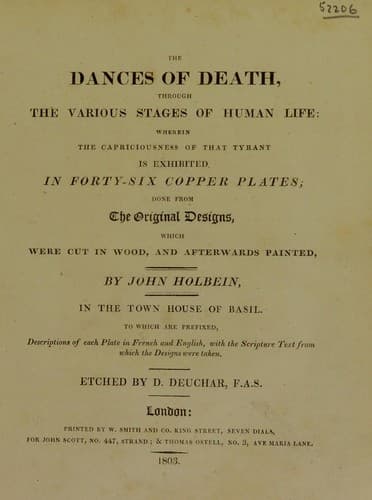
The Dances of Death: Through the Various Stages of Human Life: Wherein the Capriciousness of that Tyrant is Exhibited
Philosophy
The Dances of Death: Through the Various Stages of Human Life: Wherein the Capriciousness of that Tyrant is Exhibited
Dance of death; Dance of death in art
Here we see Death leading away, playing on a psaltery, an Old Man to the
brink of the grave, bent under the load of years, and verging to the last
degree of frailty. The Old Man allows himself to be carried off, with
that calmness and tranquillity, which are the effects of wisdom, and the
fruits of a good conscience.
[Illustration: _Spiritus meus attenuabitur, dies mei breviabuntur, &
solum mihi superest sepulchrum. Job xvii. 1._]
PLANCHE XLI.—LE VIEILLARD.
L’on voit ici la Mort qui conduit sur le bord de sa fosse, en jouant du
psalterion, un Vieillard courbé sous le poids des années, & parvenu au
dernier degré de la caducité. Le Vieillard se laisse emmener avec ce
calme & cette tranquillité qui sont l’apanage de la sagesse & les fruits
d’une bonne conscience.
PLATE XLII.—THE OLD WOMAN.
The grim countenance of this good old Dame does not indicate the same
resignation as appears in the former subject. Wholly occupied in mumbling
her rosary, she pays no attention to the sound of a dulcimer, on which
one of her conductors is playing. The other skeleton, impatient of the
slowness of the Old Woman’s march, is employing menaces and blows to make
her advance.
[Illustration: _Melior est mors quam vita. Eccle. xxx. 17._]
PLANCHE XLII.—LA VIEILLE.
Le visage rechigné de cette bonne Vieille n’annonce pas la même
résignation que dans le sujet précédent. Toute occupée à marmotter son
rosaire, elle ne prête aucune attention au son du timpanon dont joue
l’une de ses conductrices. L’autre squelette impatient de la lenteur que
la bonne Vieille met dans sa marche, emploie les menaces & les coups pour
la faire avancer.
PLATE XLIII.—THE BLIND MAN.
This poor Blind Man is following, with an air of chagrin, his new
conductor, who, without pity, is leading him through wretched roads. In
vain does he attempt, by groping his way, to avoid the obstacles that
oppose his reluctant march; he will not avoid that fatal goal to which
Death is conducting him, and which will be the only termination of his
evils.
[Illustration: _Domine vim patior. Isaiæ xxxviii. 14._
_Cæci sunt, & duces cæcorum. Cæcus autem si cæco ducatum præstet, ambo in
foveam cadunt. Matth. xv. 14._]
PLANCHE XLIII.—L’AVEUGLE.
Ce pauvre Aveugle suit d’un air chagrin son nouveau conducteur qui le
mène impitoyablement par les plus mauvais chemins; en vain veut-il
éviter, en tâtonnant, les obstacles qui s’opposent à sa marche forcée; il
n’évitera pas le terme fatal où la Mort le conduit, et qui ne sera dans
le fond que celui de ses maux.
PLATE XLIV.—THE BEGGAR.
Public-domain text, read in full here on John Shaqi.
Reviews
Reviews
No reviews yet
Be the first to share your thoughts on this work.
Join the Discussion
Join the discussion
Sign in to leave a comment or review.
Sign InorCreate an account