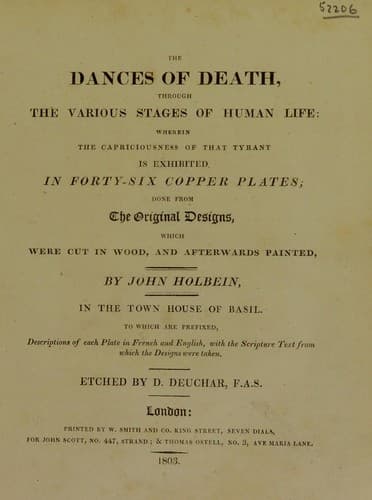
The Dances of Death: Through the Various Stages of Human Life: Wherein the Capriciousness of that Tyrant is Exhibited
Philosophy
The Dances of Death: Through the Various Stages of Human Life: Wherein the Capriciousness of that Tyrant is Exhibited
Dance of death; Dance of death in art
He appears carrying the Holy Sacrament along the street to a dying man.
Death marches before him, carrying the lantern and a little bell. He is
followed by a boy, who carries the holy water and a taper, and by a young
woman with a mournful aspect, who seems to have come in quest of him.
[Illustration: _Sum quidem & ego mortalis homo. Sap. vii. 1._]
PLANCHE XIV.—LE PRETRE.
On le voit dans la rue porter le St. Sacrement à un moribond. La Mort
marche devant lui, et porte la lanterne & la clochette. Il est suivi d’un
garçon qui porte l’eau bénite & un cierge, & d’une jeune femme affligée
qui paroît être venue le chercher.
PLATE XV.—THE PHYSICIAN.
Death is leading to him a sick old man, whose urine he is presenting to
him in a phial, and appears saying, in a jeering manner, Dost thou think
that thou art able to save a man whom I have already in my power?
[Illustration: _Medice curate ipsum. Lucæ iv. 23._]
PLANCHE XV.—LE MEDECIN.
La Mort lui amène un vieillard malade dont elle lui présente l’urine dans
une phiole, & paroît lui dire d’un air moqueur; Crois-tu pouvoir sauver
un homme que je tiens déjà en ma puissance?
PLATE XVI.—THE ASTROLOGER.
He has his eyes fixed on a sphere hanging from the ceiling, and appears
profoundly engaged in the vain chimeras of judicial astrology, while
Death comes to turn his attention upon a death-head, which he is
presenting to him in a most grotesque attitude, seeming to say, in a
jeering tone, Could thy sublime art inform thee, that I was coming to pay
thee this visit to-day?
[Illustration: _Indica mihi, si nosti, omnia sciebas. Tunc quod
nasciturus esses? & numerum dierum tuorum noveras? Job xxxviii. 18, 21._]
PLANCHE XVI.—L’ASTROLOGUE.
Il a les yeux fixés sur une sphère suspendue au plancher, & paroît
profondément occupé des vaines chimères de l’astrologie judiciaire,
tandis que la Mort vient tourner son attention sur une tête de mort,
qu’elle lui présente dans l’attitude la plus grotesque, & semble lui dire
d’un ton railleur; Ton art sublime a-t-il pu t’apprendre que je viendrois
te rendre aujourd’hui cette visite?
PLATE XVII.—THE EMPEROR.
Seated on a throne, and holding in his hand the sword of state, he is
attentively listening to an advocate pleading in a soothing tone, against
an unfortunate peasant, who trembling waits, in the most suppliant
posture, the decree that is to determine his fate. Death at this moment
displays all his power; he proudly takes possession of the bottom of
the throne, and is carelessly leaning his arm on the Monarch’s crown.
The angry aspect, with which the Emperor views the advocate and his two
clients, who are seen standing with their heads uncovered, is a happy
presage for the poor oppressed peasant. At the foot of the throne are
lying the sceptre and globe of the empire, placed on a cushion. Death has
set down his fatal glass beside these attributes of grandeur, which he
can cause to vanish at his pleasure.
Public-domain text, read in full here on John Shaqi.
Reviews
Reviews
No reviews yet
Be the first to share your thoughts on this work.
Join the Discussion
Join the discussion
Sign in to leave a comment or review.
Sign InorCreate an account