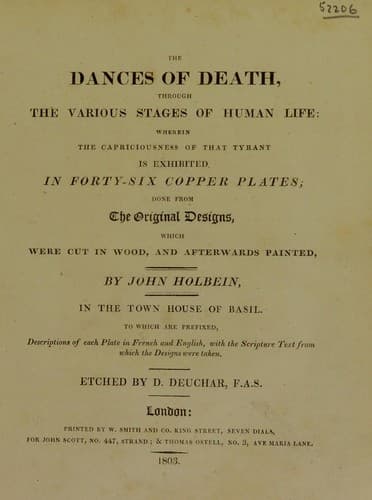
The Dances of Death: Through the Various Stages of Human Life: Wherein the Capriciousness of that Tyrant is Exhibited
Philosophy
The Dances of Death: Through the Various Stages of Human Life: Wherein the Capriciousness of that Tyrant is Exhibited
Dance of death; Dance of death in art
[Illustration: _Sedentes in tenebris & umbra Mortis: vinctos in
mendicitate. Psal. cvi. 10._]
PLANCHE X.—LE FRERE QUETEUR.
Pret à rentrer dans son couvent avec sa tire-lire & sa besace, la Mort
l’arrête à la porte, & toute aussi sourde à ses cris, qu’insensible à
l’effroi qu’elle lui cause, elle le tire de toutes ses forces par son
capuchon, & rend impuissans les efforts du bon Frère pour se dérober de
ses mains.
PLATE XI.—THE ABBE.
Death, not contented with stripping this fat Prelate of his crosier,
which he is carrying in triumph on his shoulder, and his mitre, with
which he is dressing himself, is dragging him away without pity. He
raises his breviary with one hand, and with the other is making some vain
efforts to push him off.
[Illustration: _Ipse morietur, quia non habuit disciplinam, et in
multitudine stultitiæ decipietur. Prov. v. 23._]
PLANCHE XI.—L’ABBÉ.
La Mort non contente d’avoir arraché à ce gros Prélat sa crosse, qu’elle
porte en triomphe sur son épaule, & sa mitre, dont elle s’est affublée,
le tire encore impitoyablement après elle; il élève d’une main son
breviaire, & fait de l’autre de vains efforts pour la repousser.
PLATE XII.—THE ABBESS.
Death ludicrously hooded with several flowing plumes, and robed in a
kind of gown, carries out of her convent an Abbess, whom he is dragging
with all his might by her scapulary. The reverend Mother with regret is
leaving life and the honours she enjoys; and expresses, by the alteration
of her features and by her cries, the fright that Death has produced in
her soul. Behind her, under the gate of the convent, appears a young Nun,
strangely agitated with terror and grief.
[Illustration: _Laudavi magis mortuos, quam viventes. Eccl. iv. 2._]
PLANCHE XII.—L’ABBESSE.
La Mort ridiculement coiffée de diverses plumes flottantes, & vêtue d’une
espèce de mante, emmène hors de son couvent une Abbesse qu’elle tire de
toutes ses forces par son scapulaire. La révérendissime Mère quitte à
regret la vie & les honneurs dont elle jouit, & exprime par l’altération
de ses traits & par ses cris, l’effroi que la Mort a jeté dans son
âme. On voit derrière elle, sous la porte de l’abbaye, une jeune Nonne
vivement agitée par la crainte & par la douleur.
PLATE XIII.—THE PREACHER.
As he is preaching to his congregation, Death, who is behind him with a
stole about his neck, holds over his head the bone of a dead body, and
by shewing it to the assembly, preaches to them, undoubtedly, the most
eloquent of all sermons.
[Illustration: _Væ qui dicitis malum bonum, et bonum malum: ponentes
tenebras lucem, et lucem tenebras: ponentes amarum in dulce, & dulce in
amarum. Esaiæ v. 20._]
PLANCHE XIII.—LE PREDICATEUR.
Tandis qu’il prêche son auditoire, la Mort qui est derrière lui, une
étole au cou, élève par-dessus sa tête un os de mort, & en la montrant à
l’assemblée lui fait sans doute le plus éloquent de tous les sermons.
PLATE XIV.—THE PRIEST.
Public-domain text, read in full here on John Shaqi.
Reviews
Reviews
No reviews yet
Be the first to share your thoughts on this work.
Join the Discussion
Join the discussion
Sign in to leave a comment or review.
Sign InorCreate an account