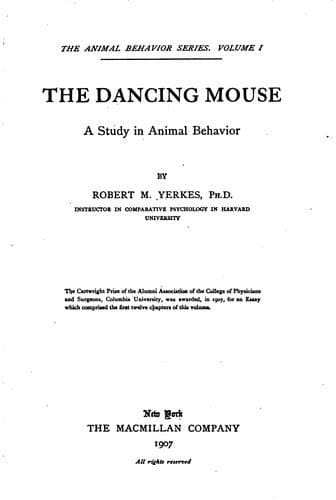
The Dancing Mouse: A Study in Animal BehaviorYerkes, Robert Mearns
Science
The Dancing Mouse: A Study in Animal Behavior
Yerkes, Robert Mearns
Animal behavior; Dancing mice
At this point we may very fittingly ask, what sense data are necessary for
the guidance of the series of acts which constitutes the labyrinth habit?
I answer, probably none. A habit once formed, the senses have done their
part; henceforth it is a motor process, whose initiation is conditioned by
the activity of a receptive organ (at times a sense receptor), but whose
form is not necessarily dependent upon immediate impressions from eye,
nose, vibrissae, or even from internal receptors. These are statements of
my opinion; whether they express the truth, either wholly or in part, only
further experimentation can decide.
In considering the results of these labyrinth tests it is important that
we distinguish clearly those which have to do with the conditions of habit
formation from those which instead have to do with the conditions of habit
performance. Sense data which are absolutely necessary for the learning of
a labyrinth path may be of little or no importance for the execution of
the act of following the path after the learning process has been
completed. Thus far in connection with the labyrinth tests we have
discussed only the relations of sight, touch, and smell to what I have
called habit performance. We may now ask what part these senses play in
the formation of a labyrinth habit.
A very definite answer to this question is furnished by observation of the
behavior of the dancers in the tests. Most of them continuously made use
of their eyes, their noses, and their vibrissae. Some individuals used one
form of receptive organ almost exclusively. I frequently noticed that
those individuals which touched and smelled of the labyrinth passages most
carefully gave least evidence of the use of sight. It is safe to say,
then, that under ordinary conditions habit formation in the dancer is
conditioned by the use of sight, touch, and smell, but that these senses
are of extremely different degrees of importance in different individuals.
And further, that, although in the case of some individuals the loss of
sight would not noticeably delay habit formation, in the case of others it
would seriously interfere with the process. When deprived of one sense,
the dancer depends upon its remaining channels of communication with
environment. Indeed there are many reasons for inferring that if deprived
of sight, touch, and smell it would still be able to learn a labyrinth
path; and there are reasonable grounds for the belief that a habit once
formed can be executed in the absence of all special sense data.
Apparently the various receptive organs of the body furnish the dancer
with impressions which serve as guides to action and facilitate habit
formation, although they are not necessary for habit performance.
Public-domain text, read in full here on John Shaqi.
Reviews
Reviews
No reviews yet
Be the first to share your thoughts on this work.
Elsewhere in the archive
Join the Discussion
Join the discussion
Sign in to leave a comment or review.
Sign InorCreate an account