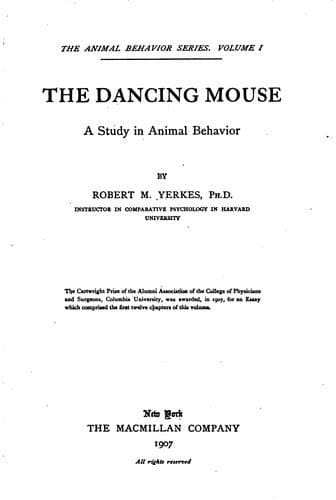
The Dancing Mouse: A Study in Animal BehaviorYerkes, Robert Mearns
Science
The Dancing Mouse: A Study in Animal Behavior
Yerkes, Robert Mearns
Animal behavior; Dancing mice
The reader may wonder why I have not carried out systematic experiments to
determine accurately and quantitatively the part which each sense plays in
the formation of a labyrinth habit instead of basing my inferences upon
incidental observation of the behavior of the dancers. The reason is
simply this: the number and variety of experiments which were suggested by
the several directions in which this investigation developed rendered the
performance of all of them impossible. I have chosen to devote my time to
other lines of experimentation because a very thorough study of the
conditions of habit formation has recently been made by Doctor Watson.[1]
[Footnote 1: Watson, J. B., _Psychological Review_, Monograph Supplement,
Vol. 8, No. 2, 1907.]
What is the role of sight in the dancing mouse? How shall we answer the
question? The evidence which has been obtained in the course of my study
of the animal indicates that brightness vision is fairly acute, that color
vision is poor, that although form is not clearly perceived, movement is
readily perceived. My observations under natural conditions justify the
conclusion that sight is not of very great importance in the daily life of
the dancer, and my observations under experimental conditions strongly
suggest the further conclusion that movement and changes in brightness are
the only visual conditions which to any considerable extent control the
activity of the animal.
CHAPTER XII
EDUCABILITY: METHODS OF LEARNING
Nearly all of the experiments described in earlier chapters have revealed
facts concerning the educability of the dancer. In order to supplement the
knowledge of this subject thus incidentally gained and to discover the
principles of educability, the specially devised experiments whose results
appear in this and succeeding chapters were arranged and carried out with
a large number of mice. In the work on the modifiability of behavior I
have attempted to determine (1) by what methods the dancer is capable of
profiting by experience, (2) the degree of rapidity of learning, (3) the
permanency of changes wrought in behavior, (4) the effect of one kind of
training upon others, (5) the relation of re-training to training, and (6)
the relation of all these matters to age, sex, and individuality.
As it is obvious that knowledge of these subjects is a necessary condition
for the intelligent appreciation of the capacities of an animal, as well
as of the choice of methods by which it may be trained advantageously,
perhaps it is not too much to expect that this investigation of the nature
and conditions of educability in the dancing mouse may give us some new
insight into the significance of certain aspects of human education and
may serve to suggest ways in which we may measure and increase the
efficiency of our educational methods.
Public-domain text, read in full here on John Shaqi.
Reviews
Reviews
No reviews yet
Be the first to share your thoughts on this work.
Elsewhere in the archive
Join the Discussion
Join the discussion
Sign in to leave a comment or review.
Sign InorCreate an account