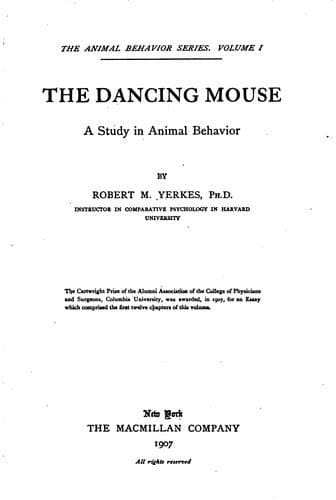
The Dancing Mouse: A Study in Animal BehaviorYerkes, Robert Mearns
Science
The Dancing Mouse: A Study in Animal Behavior
Yerkes, Robert Mearns
Animal behavior; Dancing mice
Merely for the sake of convenience of description I shall classify the
methods which have been employed as problem methods, labyrinth methods,
and discrimination methods. That these names are not wholly appropriate is
suggested by the fact that discrimination necessarily occurs in connection
with each of them. As problem methods we may designate those tests of
initiative and modifiability which involve the opening of doors by pushing
or pulling them, and the climbing of an inclined ladder. An example of the
labyrinth method has been presented in Chapter XI. The name discrimination
method I have applied to those tests which involve the choice of one of
two visual, tactual, or olfactory conditions. The white-black
discrimination tests, for example, served to reveal the rapidity and
permanency of learning as well as the presence of brightness vision.
In the case of most mammals whose educability has been studied
experimentally, problem methods have proved to be excellent tests of
docility and initiative. The cat, the raccoon, the monkey, in their
attempts to obtain food, learn to pull strings, turn buttons, press
latches, slide bolts, pull plugs, step on levers. The dancer does none of
these things readily. Are we therefore to infer that it is less
intelligent, that it is less docile, than the cat, the raccoon, or the
monkey? Not necessarily, for it is possible that these methods do not suit
the capacity of the animal. As a matter of fact, all of the tests which
are now to be described in their relation to the educability of the dancer
bear witness to the importance of the selection of methods in the light of
the motor equipment and the habits of the animal which is to be tested.
Judged by ordinary standards, on the basis of results which it yields in
problem and labyrinth tests, the dancer is extremely stupid. But that this
conclusion is not justified is apparent when it is judged in the light of
tests which are especially adapted to its peculiarities.
Problems which are easy for other mammals because of their energetic and
persistent efforts to secure food in any way which their motor capacity
makes possible are useless as tests of the dancer's abilities, because it
is not accustomed to obtain its food as the result of strenuous and varied
activities. There are problems and problems; a condition or situation
which presents a problem to one organism may utterly lack interest for an
organism of different structure and behavior. What is a problem test in
the case of the cat or even of the common mouse, is not necessarily a
problem for the dancer. Similarly, in connection with the labyrinth
method, it is clear that the value of the test depends upon the desire of
the organism to escape from the maze. The cat, the rat, the tortoise do
their best to escape; the dancer is indifferent. Clearly, then, methods of
training should be chosen on the basis of a knowledge of the
characteristics of the animal whose educability is to be investigated.
Public-domain text, read in full here on John Shaqi.
Reviews
Reviews
No reviews yet
Be the first to share your thoughts on this work.
Elsewhere in the archive
Join the Discussion
Join the discussion
Sign in to leave a comment or review.
Sign InorCreate an account